


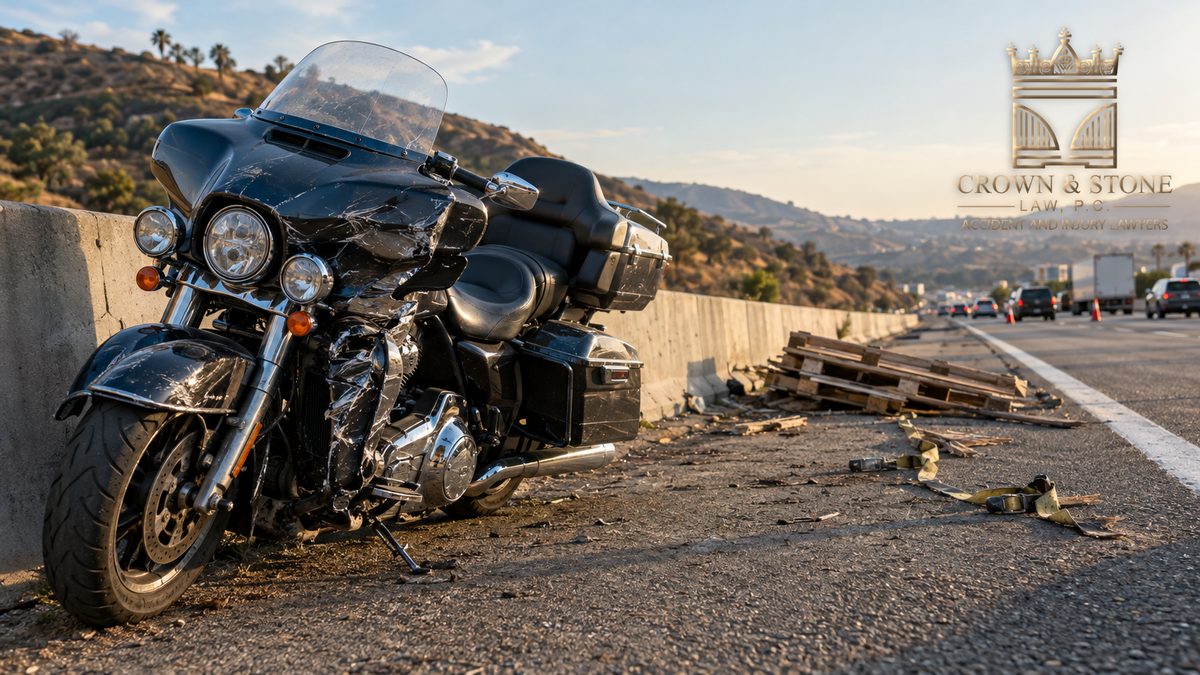
A dropped ladder can cause a motorcycle crash without the hauling vehicle ever touching the bike. Crown & Stone Law, P.C. represents clients throughout California in these claims, with direct attorney access and investigation focused on where the cargo came from. California Vehicle Code section 23114 requires vehicles to be loaded so their contents do not drop, spill, or otherwise escape, subject to limited exceptions. But finding debris beside a wreck is not enough; the claim still needs evidence connecting that load to the crash.
What evidence should I preserve right after dropped cargo causes my motorcycle crash?
Once emergency needs are handled, useful evidence includes the exact location, witness contacts, original camera files, and photographs taken from a safe place. Do not enter traffic to retrieve the object; a witness who saw it fall may be more useful than possession of the debris. California Highway Patrol’s collision-report process allows eligible involved parties to request the report using form CHP 190. A lawyer can also seek nearby camera footage and send preservation requests, but a request cannot recover footage already erased.
Can I bring a California motorcycle injury claim if the cargo truck never touched my bike?
Yes, lack of vehicle-to-bike contact does not by itself defeat a negligence claim against an identified responsible party. The Judicial Council of California’s CACI No. 400 requires proof of negligence, harm, and a causal connection between them. California Vehicle Code section 23114 supplies the load-containment rule, but a violation alone does not establish every part of the injury claim. Witness accounts, footage of falling cargo, and evidence about straps or loading can matter more than damage to the hauling vehicle.
What if the vehicle that dropped the debris left and nobody got its plate?
A missing plate makes identification harder, but it does not end the search; vehicle markings, witness recordings, and nearby business cameras may provide leads. California Insurance Code section 11580.2 generally requires physical contact for uninsured-motorist claims involving an unknown vehicle, along with reporting and statement requirements. Whether contact through dropped cargo satisfies that rule can depend on the evidence and applicable law, so hitting debris does not automatically establish coverage. Have the policy and reporting deadlines reviewed promptly rather than assuming every hit-and-run provision covers a no-contact crash.
Can the trucking company or cargo loader be liable for debris that knocked me off my motorcycle?
Potentially, but responsibility follows evidence of who loaded, checked, controlled, or transported the cargo – not simply whose name appears on the trailer. For covered commercial operations, the Federal Motor Carrier Safety Administration’s rules in 49 CFR sections 392.9 and 393.100 address cargo inspection and protection against shifting or falling loads. Claims involving cargo dropped by commercial trucks may call for loading records, inspection records, and contracts identifying each company’s role. Federal rules do not apply to every pickup carrying furniture, and multiple businesses are not automatically liable.
Can the insurer blame me for swerving or following too closely before hitting the debris?
It can raise those arguments, but an accusation is not proof. The Judicial Council of California’s CACI No. 405 explains that a rider’s share of negligence can reduce damages rather than automatically bar recovery. Video, sight lines, traffic spacing, and the time available to react can help test whether the rider had a realistic chance to avoid the load. A claim should address those details, not assume that every emergency swerve was either reasonable or careless.
What happens after I hire a lawyer, and how long do I have to file in California?
The initial work usually centers on identifying the hauling vehicle, preserving records, reviewing coverage, and documenting injuries; a demand may follow once the evidence supports it. California Code of Civil Procedure section 335.1 generally gives an injured person two years to file a personal injury lawsuit, though exceptions can change that period. The California Courts Self-Help Guide explains that claims against public entities generally require an administrative claim within six months, which may matter if a public vehicle or roadway condition is involved. Those deadlines are not evidence-preservation windows, and waiting for a complete recovery can leave gaps that a later lawsuit cannot fix.
How Crown & Stone Law, P.C. Investigates Motorcycle Debris Claims
Crown & Stone Law, P.C. serves California riders from Beverly Hills, with direct attorney access and plain-English explanations that clients describe as calming after a crash. Its investigation-driven approach fits dropped-cargo cases: accident mechanics and proof of the load’s origin need attention before a liability argument can hold up, with litigation preparation when responsibility remains disputed. BBB lists the firm as accredited with an A+ rating since October 16, 2025. That credential does not prove a debris claim; the better test is whether the lawyer can explain the missing evidence, the insurance limits, and the plan for addressing both.