


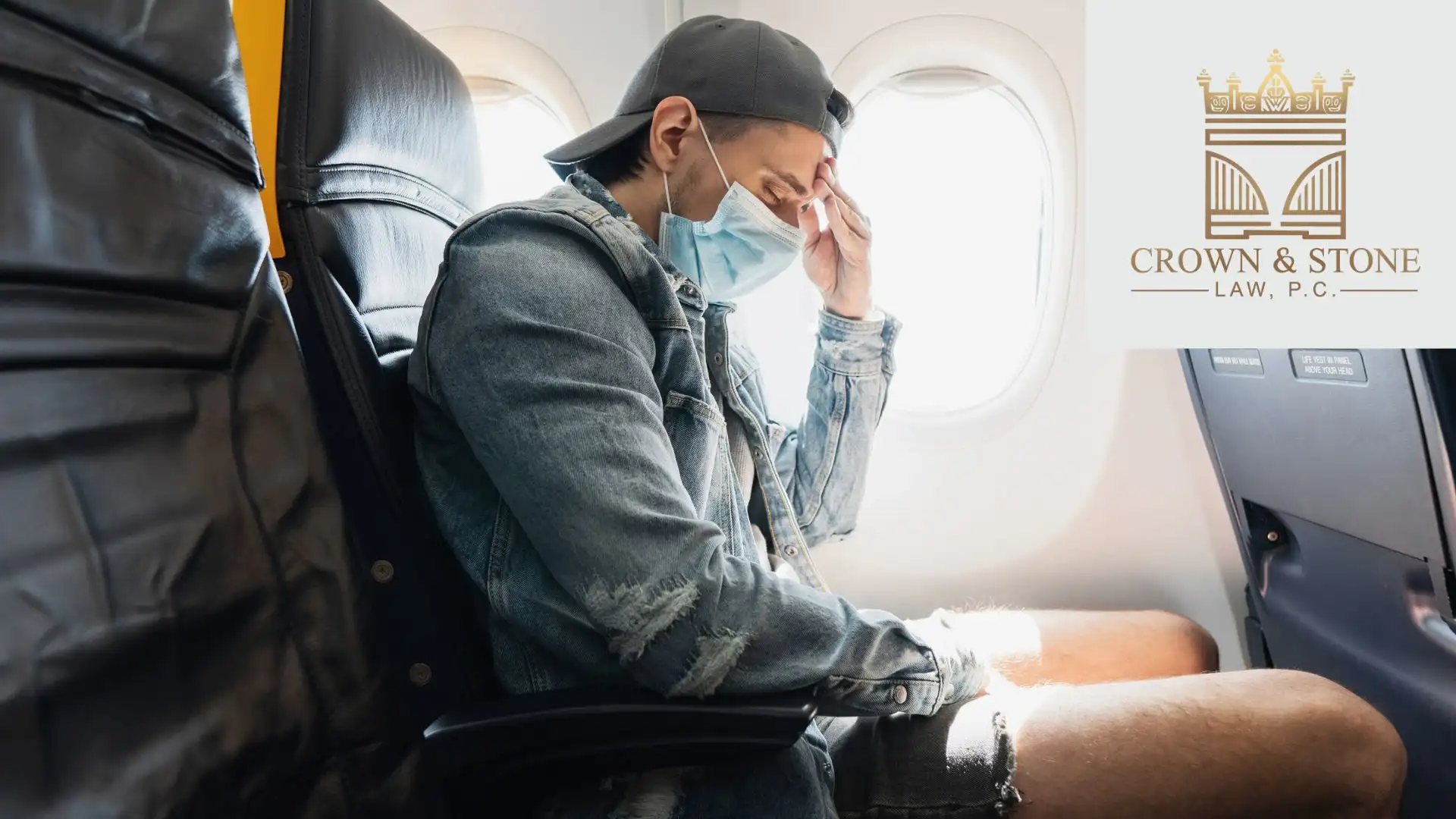
You expect a long-haul flight to be uncomfortable. You don’t expect to be thrown into the ceiling by turbulence, hit by a suitcase falling from an overhead bin, or burned by hot coffee during meal service. When it happens, many travelers assume there is nothing they can do because the airline is huge, foreign, or “not responsible for turbulence.”
That assumption is often wrong. If you were injured on an international flight, an international treaty called the Montreal Convention gives you rights that can be stronger than an ordinary injury claim. This guide explains those rights in plain English: what kinds of injuries qualify, how much the airline must pay without a fight over fault, where you can file, and the deadline you cannot afford to miss.
Key takeaways
- On international flights, the airline is liable for passenger injuries caused by an onboard “accident” without you proving fault, for damages up to 151,880 SDRs (about $205,000). There is no upper cap.
- Severe turbulence, falling luggage, hot drink spills caused by the crew or equipment, and boarding falls are common examples.
- You have two years from the flight’s arrival to file suit. Courts in California will not extend it.
- If you live in the U.S. or your trip started and ended here, you can usually file your case in Los Angeles, even against a foreign airline.
Quick Facts: The Montreal Convention at a Glance
| What it is | A 1999 international treaty governing airline liability on international flights. The U.S. and about 140 other parties have joined it. |
|---|---|
| Who it covers | Passengers on “international carriage,” including domestic legs booked on the same ticket as an international trip. |
| No-fault amount | 151,880 SDRs per passenger (about $205,000 as of November 2026), for accidents on or after December 28, 2024. Earlier accidents: 128,821 SDRs. |
| Above that amount | No cap. The airline pays unless it proves it was not negligent or the harm was caused solely by a third party. |
| Filing deadline | 2 years from arrival (or scheduled arrival). Not extendable. |
| Punitive damages | Not allowed. |
| Exclusive remedy? | Yes. If the treaty applies, it replaces ordinary state-law injury claims against the airline. |
Why International Flight Injuries Are Different
Most injury claims require you to prove someone was negligent. International air travel works differently. The Montreal Convention sets uniform rules for what happens when a passenger is hurt on an international flight, and in U.S. courts it is the exclusive way to bring that claim against the airline.
Here is the part most travelers never hear about: for the first portion of your damages, the airline is responsible regardless of fault. You don’t have to prove the pilot made a mistake or the crew broke a rule. You need to show that an “accident” on the plane, or while you were boarding or getting off, caused your bodily injury.
That no-fault amount is 151,880 Special Drawing Rights (SDRs), an international unit of value set by the International Monetary Fund. In early November 2026, that was roughly $205,000. The limit was raised from 128,821 SDRs on December 28, 2024, as part of the treaty’s inflation review every five years, so the date of your flight matters. For damages above the limit, there is no cap: the airline must pay unless it proves the injury was not caused by its negligence, or was caused solely by someone else.
What counts as an “accident”?
The U.S. Supreme Court has defined an accident as an unexpected or unusual event that is external to the passenger (Air France v. Saks, 1985). It doesn’t have to be a crash. It just has to be something that happened to you, as opposed to your own body’s reaction to a normal flight. The Court has also held that a flight crew’s unusual refusal to help a passenger in medical distress can be an accident (Olympic Airways v. Husain, 2004).
The “external” part matters. Courts have rejected claims where the airline showed the injury was caused by the passenger’s own movement, such as bumping their own drink, rather than something the crew, the aircraft, or another passenger did. That is why witness names and a written incident report are so valuable.
Turbulence: The Leading Cause of In-Flight Injuries
According to the National Transportation Safety Board, turbulence was involved in more than one-third of U.S. airline accidents between 2009 and 2018, and nearly all seriously injured passengers were not wearing their seatbelts. Major turbulence events have continued to make news through 2025 and 2026, including incidents where passengers and meal carts were thrown into the cabin ceiling.
Courts generally treat severe or unexpected turbulence that injures a passenger as an accident under the treaty. Claims involving light, routine bumps are harder, because ordinary turbulence is a normal part of flying. If the seatbelt sign was off when the turbulence hit, that can strengthen your claim. If it was on and you were out of your seat, the airline will likely argue your compensation should be reduced.
Common In-Flight Injuries That May Qualify
- Turbulence injuries. Passengers thrown into the ceiling, armrests, or aisle, or struck by a beverage cart during sudden turbulence.
- Falling luggage. A heavy bag falls from an overhead bin opened by a flight attendant or another passenger, causing head, neck, or shoulder injuries.
- Hot drink and food burns. Coffee, tea, or soup spilled onto a passenger by a crew member, a tipping tray table, or a jolt of turbulence.
- Beverage cart injuries. A service cart slams into the knee, elbow, or foot of someone in an aisle seat.
- Broken or dangerous cabin equipment. Collapsing seats, falling tray tables or panels, or hardware that should not have been there.
- Boarding and exiting falls. Slipping on wet airstairs or a jet bridge, or being dropped during airline-provided wheelchair assistance.
- Medical emergencies made worse by the crew. For example, a crew refusing a reasonable request for help, or an airline losing a passenger’s essential medication or breathing device.
- Assaults or misconduct by other passengers, depending on the circumstances and whether a bodily injury resulted.
- Allergic reactions after the airline served a food you specifically told it you could not eat.
Connecting flights count too. If you were hurt on a domestic leg of an international trip, like LAX to San Francisco before continuing to Tokyo on the same ticket, the Montreal Convention can still apply. And if you booked through one airline but flew on its codeshare partner, you can generally pursue either the airline that sold the ticket or the one that operated the flight.
What Usually Isn’t Covered
- Blood clots (DVT) from sitting still on a long flight, without some unusual event.
- Ear or sinus pain from normal changes in cabin pressure.
- Emotional distress alone. In U.S. courts, a frightening flight, rude treatment, or a humiliating search usually isn’t enough without a bodily injury.
- Punitive damages. The treaty doesn’t allow damages meant to punish the airline.
Your compensation may also be reduced if the airline proves your own carelessness contributed to the injury, for example, ignoring the seatbelt sign during announced turbulence.
What Compensation Can You Recover?
- Medical bills, past and future
- Lost wages and reduced ability to work
- Pain and suffering
- Emotional distress that flows from your physical injury
- In the most serious cases, wrongful death damages for the family
Can I File My Airline Injury Case in Los Angeles?
The Montreal Convention limits which countries can hear your case. For an injury claim, you can generally file in the country:
- Where the airline is based or has its principal place of business,
- Where the airline has a place of business through which you bought your ticket,
- That is the final destination on your ticket (for a round trip, usually where you started), or
- Where you permanently lived at the time of the accident, if the airline flies passengers to and from that country (directly or through a codeshare partner) and does business there from offices it leases or owns.
In plain terms, here is how that usually plays out:
| Your situation | Can you usually file in California? |
|---|---|
| You live in California and flew round trip from LAX on any airline | Yes, in most cases |
| You live in California and flew one way from LAX to another country | Often yes |
| You were hurt on a U.S. airline flight in or out of LAX | Often yes |
| You live in California but were hurt on a flight between two foreign cities, booked separately while traveling | Possibly. This needs a closer look. |
| You live abroad and flew a foreign airline on a ticket bought in your home country | Often no. You may need to file in your home country. |
Many of these cases end up in federal court in Los Angeles, because they arise under a treaty and often involve airlines based outside California. A small number of countries never joined the Montreal Convention and follow the older Warsaw Convention instead, which has different rules. A lawyer can review your ticket and itinerary to confirm which treaty applies and where to file.
The 2-Year Deadline You Can’t Miss
Important: Under Article 35 of the Montreal Convention, you must file your lawsuit within two years of the date the plane arrived at its destination, the date it should have arrived, or the date the flight was stopped.
This deadline is stricter than most. The federal appeals court that covers California has held that it cannot be paused or extended, and that it runs from the flight’s arrival, not from when you discovered how serious your injury was (Narayanan v. British Airways, 9th Cir. 2014). Waiting to “see how you heal” can cost you your entire claim. The sooner a lawyer gets involved, the easier it is to gather evidence while it still exists.
Hurt at LAX, Not on the Plane?
Injuries inside the terminal, such as on an escalator, moving walkway, wet floor, or shuttle, are usually handled under different rules. LAX is operated by Los Angeles World Airports, a department of the City of Los Angeles, and California generally requires a formal claim against a public entity to be presented within six months. Some terminal injuries involve private companies, like airlines, concessionaires, or contractors, instead. If you were injured at the airport itself, contact a lawyer as soon as possible.
What About Domestic Flights?
If your trip was entirely within the U.S., like LAX to New York, the Montreal Convention usually doesn’t apply. That doesn’t mean you’re out of luck. You would generally need to show the airline was negligent. California law treats airlines as common carriers that owe passengers a heightened duty of care, though federal aviation regulations may define the standard on some safety issues. California’s general deadline for personal injury lawsuits is two years.
What to Do After an In-Flight Injury
- Tell the flight crew right away and ask that the incident be written up. Note the names of crew members who helped you.
- Take photos and video of your injury, your seat area, the overhead bin, spilled liquids, the seatbelt sign, or anything else involved.
- Get contact information from passengers who saw what happened. In disputes over what caused a spill or fall, independent witnesses often decide the case.
- Keep your boarding pass, ticket confirmation, and full itinerary. These determine which rules apply and where you can file.
- See a doctor promptly, even if you feel okay. Head and back injuries often get worse over the following days, and medical records help prove your claim.
- Be careful with airline offers. Airlines sometimes offer travel vouchers or small payments. Talk to a lawyer before signing anything that releases your claim.
- Don’t wait. Remember the two-year deadline.
Frequently Asked Questions
Can I sue an airline for a turbulence injury?
Often, yes. On an international flight, severe or unexpected turbulence that injures a passenger is generally treated as an accident under the Montreal Convention, so you may recover up to 151,880 SDRs (about $205,000) without proving the airline was careless. Courts have been less receptive when the turbulence was light and routine, and your compensation can be reduced if you ignored the seatbelt sign.
How long do I have to file a claim for an injury on an international flight?
Two years from the date the plane arrived at its destination, the date it should have arrived, or the date the flight was stopped. The deadline is written into the Montreal Convention, and federal courts in California have held it cannot be extended or paused.
Do I have to prove the airline was negligent?
Not for the first 151,880 SDRs (about $205,000) of your damages. Above that amount, the airline must pay unless it proves it was not negligent or that the injury was caused solely by someone else. There is no upper cap.
The airline is foreign. Can I still sue it in California?
Often, yes. You can usually sue in the United States if your ticket’s final destination was in the U.S., you bought the ticket through the airline’s U.S. business, or you live in the U.S. and the airline flies to and does business here. A lawyer should review your ticket and itinerary to confirm.
Can I get compensation for emotional distress after a scary flight?
In U.S. courts, usually only if you also suffered a bodily injury. Emotional distress that flows from a physical injury can be part of your claim, but fear or anxiety alone generally is not enough under the Montreal Convention.
What if I was injured inside the LAX terminal, not on the plane?
Different rules may apply. LAX is operated by Los Angeles World Airports, a City of Los Angeles department, and a claim against the City generally must be presented within six months. Some terminal injuries involve private companies instead. Contact a lawyer right away.
How much does it cost to hire a lawyer for an airline injury case?
Many personal injury lawyers, including Crown & Stone Law, handle these cases on a contingency fee basis, meaning attorney fees are a percentage of any recovery. Ask how fees and case costs work during your free consultation.
Talk to a Los Angeles International Flight Injury Lawyer
If you were hurt by turbulence, falling luggage, a hot drink spill, or another incident on an international flight, Crown & Stone Law can review your ticket, your injuries, and your options. The deadline is short, so don’t wait to get answers. Consultations are free, and you’ll speak directly with an attorney.