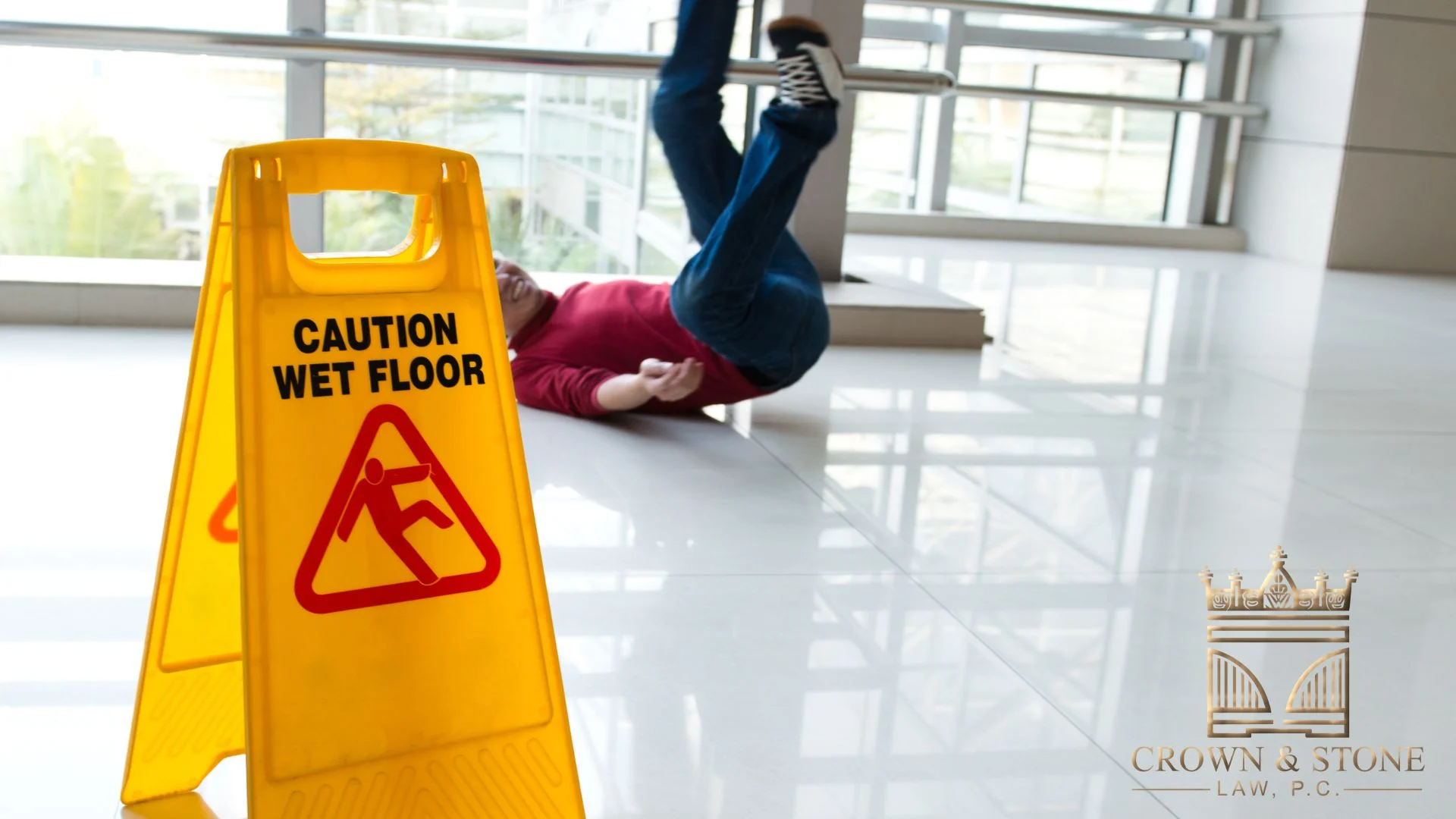

If you are reading this, the initial shock of the injury has likely worn off, replaced by the daunting reality of mounting medical bills and the confusing prospect of holding a commercial property owner accountable.
You might be wondering if your incident qualifies as a legitimate claim or if a corporate giant like Walmart or a local property management firm will simply brush you aside.
The difference between a dismissed complaint and a maximum-value settlement often isn’t the severity of the injury, it’s the quality of the evidence and the legal theory applied to it.
At Crown & Stone Law, P.C., we know that commercial injury cases are won in the details. While generic “slip and fall” advice floods the internet, successful litigation requires digging deeper, like looking into internal store manuals, surveillance retention policies, and the legal nuances of “constructive notice.”
We’ll help you evaluate the strength of your potential claim and understand how we dismantle the defenses of major retailers and commercial property owners.
Understanding the Liability Litmus Test
The single biggest hurdle in any retail or commercial injury case is proving negligence. It is not enough to show that you were injured on the property, you must prove that the property owner or manager failed in their duty to keep you safe.
When we evaluate a case at Crown & Stone Law, we look for three distinct types of notice. This is the framework you should use to assess your own situation:
1. Actual Notice
This is the “smoking gun.” It means an employee actually knew about the hazard before you were injured.
- Example: A customer told a manager about a spill in Aisle 4, but 20 minutes later, no one had cleaned it up, and you slipped.
- The Evidence: Witness statements, employee text messages, or audio from surveillance feeds.
2. Constructive Notice
This is where most cases are fought and won. The law acknowledges that a store cannot plead ignorance just because they “didn’t see it.” If a hazard existed for a long enough duration that they should have known about it through reasonable inspection, they are liable.
- The “Time-Duration” Factor: If a jug of milk was leaking for an hour, a reasonable inspection schedule (usually every 15–30 minutes in high-traffic zones) would have caught it.
- The Evidence: “Crusting” or footprints through a spill indicate it wasn’t fresh. Video timestamps are critical here.
3. The “Mode of Operation” Rule
This is a sophisticated legal argument used in specific jurisdictions and scenarios. It suggests that if the way a business operates creates foreseeable risks, you don’t need to prove they knew about the specific hazard that hurt you.
- Example: A grocery store offering self-service grapes or a salad bar. Spills are a foreseeable result of the business model. The store has a heightened duty to monitor these areas.
- Why It Matters: This shifts the burden of proof, making it harder for the defense to claim they were unaware of the danger.
The Intricacy of Commercial Hazards
While wet floors account for many injuries, commercial negligence manifests in many ways. Limiting your understanding to “slips” can leave compensation on the table.
Falling Merchandise and High Stacking
In “warehouse-style” retailers like Home Depot, Lowe’s, or Costco, merchandise is often stacked high above shoppers’ heads.
- The Hazard: Improperly secured pallets, “sky-shelving” violations, or customers attempting to reach items because staff was unavailable.
- The Legal Angle: We request the store’s specific “stacking height” guidelines. If an employee stacked a heavy box in violation of their own internal safety manual (SOP), that is strong evidence of negligence.
Negligent Security and Lighting
Commercial property owners have a duty to prevent foreseeable criminal acts and confirm safe handling.
- The Scenario: You are assaulted in a dimly lit parking garage, or you trip over a curb because the overhead lights were burnt out.
- The Evaluation: We analyze crime grids for the area. If the property owner knew the area was high-risk but failed to hire security guards or fix lighting, they may be liable for your injuries.
Aisle Obstruction
Retailers often clutter aisles with “impulse buy” displays or leave stocking pallets unattended.
- The Violation: The Americans with Disabilities Act (ADA) and local fire codes mandate specific aisle widths. If a pallet narrowed the walkway and caused you to trip, the violation of these codes serves as evidence of negligence per se.
The Surveillance Footage “Kill Switch”
Time is your greatest enemy in a commercial injury claim.
Most major retailers and commercial properties use digital surveillance systems that operate on a “loop.” Depending on the system, footage is automatically overwritten every 30 to 90 days unless it is manually preserved.
However, the most critical window is the first 48 hours. This is when Incident Reports are filed, and witnesses are still reachable.
Preserving Evidence
If a store knows (or should know) that a lawsuit is likely, they have a legal duty to preserve evidence. If they delete the footage anyway, it is called Spoliation of Evidence.
When we represent a client, we immediately issue a Preservation Letter. This legal document demands the retention of:
- Surveillance footage (from multiple angles, not just the fall).
- Cleaning logs and inspection sheets for the day of the incident.
- Employee training manuals and disciplinary records.
- Internal emails regarding the incident.
The Consequence: If a store destroys evidence after receiving this letter, the court can instruct a jury to assume the missing evidence would have hurt the store’s case. This often forces the defense to settle.
The “Big Box” Defense Playbook
Corporate defendants typically rely on two main arguments to devalue your claim. Understanding them is the first step to defeating them.
Defense 1: “It Was Open and Obvious”
They will argue that the pallet you tripped over or the puddle you slipped in was so visible that you should have avoided it.
- The Counter-Argument: We look for “distractions.” Retailers spend millions designing displays specifically to draw your eye up and away from the floor. They cannot distract you with marketing on one hand and blame you for not looking at your feet with the other.
Defense 2: Comparative Negligence
They may admit some fault but argue you were 50% responsible (e.g., looking at your phone).
- The Reality: Even if you were partially at fault, you can still recover damages in California. Do not let an insurance adjuster convince you that your potential mistake eliminates your right to compensation.
Evaluating Your Case Value
Prospects often ask, “What is my case worth?” While online calculators are gimmicks, real valuation is based on data.
Research and settlement data indicate a massive valuation gap—often 5x to 10x—between cases involving “soft tissue” injuries (bruising, sprains) and those requiring surgical intervention or resulting in long-term impairment.
We calculate value based on:
- Economic Damages: Past and future medical bills, lost wages, and loss of earning capacity.
- Non-Economic Damages: Pain, suffering, and the loss of enjoyment of life.
- Liability Strength: How clearly we can prove the store’s negligence via the evidence mentioned above.
The Next Step in Your Evaluation
If you have been injured on commercial property, you are essentially in a race against the store’s risk management team. They are already working to minimize their liability. You need a team working just as hard to maximize your recovery.
At Crown & Stone Law, P.C., we combine compassionate client care with aggressive litigation tactics. We understand that this isn’t just a “case” to you, it’s your recovery and your financial future.
Do not let the evidence disappear. If you are ready to evaluate your claim with a team that understands the intricacies of commercial liability, we invite you to discuss your options with us.