


No reliable single average exists for a California personal injury settlement, which is an amount agreed before trial. A verdict, by contrast, is the amount a jury decides. The real figure depends on the injury, who was at fault, and how much insurance is available to pay.
A headline figure cannot tell you what your case is worth, so this post walks through the order that matters: value, fault reduction, collectible limit, liens and deadlines.
Avi E. Muhtar of Crown & Stone Law, P.C. explains each step to clients directly.
Key Takeaways
- There is no reliable single average: most California injury claims settle for about $3,000 to $75,000, and serious injuries can settle for far more.
- A settlement is calculated in order: total the damages, reduce them for your share of fault, then cap the result at the insurance coverage actually collectible.
- Liens, case costs and deadlines shape what you keep: most claims must be filed within two years, but claims against a city or county have a six-month deadline.
Is There An Average California Personal Injury Settlement?
No. A single average misleads, because a few very large cases and a mix of unlike claims pull the number away from what most claims settle for.
As a rough guide, most California injury claims settle for about $3,000 to $75,000, and serious injuries can settle for far more. Nationally, the Insurance Research Council found that the average auto bodily injury claim payment rose from about $14,000 in 2017 to more than $20,000 in 2022.
An average blends a whiplash claim, a grocery-store fall and a spinal cord injury into one figure that describes almost no real claim. Confidential settlements never reach the public record, so published figures come from a skewed sample.
Before you trust any quoted figure, ask what it measures, its source, its date, and whether it is a mean or a median. A mean is the total divided by the count, so one huge case drags it up. A median is the middle case, which sits closer to typical.
Settlement Ranges By Injury Severity
There are four practical severity tiers, and each is valued by different evidence. The higher tiers vary far more, because the losses last longer and the proof is more contested.
- Soft-tissue injuries such as sprains and whiplash: often $3,000 to $15,000, valued mainly on treatment records and how fully you healed.
- Fractures and surgery: usually $25,000 to $150,000, valued on imaging, surgical reports and the surgeon’s view of lasting limits.
- Catastrophic injuries such as brain or spinal cord damage: from $250,000 to several million dollars, valued on a life-care plan, which is a medical projection of lifetime care and its cost.
- Wrongful death: valued on the financial support and companionship the family lost.
These ranges are broad guides, not a prediction for your case. Published figures come from verdict and settlement reporters and insurer closed-claim data. Reporters over-represent trials, which skew high, and they miss confidential settlements entirely.
Five factors typically push a case into the highest tier:
- Permanent impairment documented by treating doctors.
- A life-care plan supporting decades of future care.
- Lost earning capacity, which means a reduced ability to earn in the future.
- A commercial defendant with high coverage limits.
- Clear liability, so fault is not seriously disputed.
How Is A California Settlement Calculated?
A California settlement is calculated in order: total the damages, reduce them for your share of fault, then cap the result at the coverage actually collectible. Two similar injuries can settle very differently because of steps two and three.
The same order applies to a car accident claim or a fall in a store parking lot.
Economic And Non-Economic Damages
Economic damages are measurable losses such as medical bills and lost earnings. Non-economic damages cover pain, suffering and loss of enjoyment of life.
Economic damages include past and future medical care, lost wages, lost earning capacity and property damage. Non-economic damages have no fixed formula. The 1.5x to 5x multiplier is an insurer shortcut, not the legal rule, and insurers weigh the medical evidence behind the injury.
Howell Limits Past Medical Damages
Howell limits past medical damages to the amount actually paid or incurred, not the amount first billed. The California Supreme Court set this rule in Howell v. Hamilton Meats (2011).
A $60,000 hospital bill that a health insurer paid at $22,000 supports about $22,000 in past medical damages. Future care is valued separately, usually through medical testimony or a life-care plan.
Worked Example With Fault And Limits
In this hypothetical rear-end crash, the damages total is reduced by the injured driver’s fault percentage under Li v. Yellow Cab, then capped at the available policy limit. Policy limits are the most an insurer will pay under a policy.
These numbers are invented to show the method:
- Past medical: $60,000 billed becomes $22,000 actually paid, under Howell.
- Lost wages: add $8,000, for $30,000 in economic damages.
- Non-economic estimate: add $60,000, for total damages of $90,000.
- Comparative fault of 20%: $90,000 minus $18,000 leaves $72,000.
- At-fault driver’s limit: the policy pays $30,000 per person, leaving a $42,000 gap.
- UIM: underinsured motorist coverage on the injured driver’s own policy, with a $50,000 limit, is reduced by the $30,000 already paid, so it adds $20,000.
- Collectible total: $30,000 plus $20,000 equals $50,000.
California uses pure comparative fault, which means recovery shrinks by your percentage of fault but is never barred. Here, $90,000 in damages produced $50,000 collectible. No average could have predicted that gap.
Can A California Case Exceed $1 Million?
Yes, but only when serious damages meet collectible coverage. Policy limits, commercial defendants, multiple defendants and life-care plans decide whether a case passes $1 million or stalls near $30,000.
The state’s auto insurance requirements set only a floor, and SB 1107 raised it on January 1, 2025. A driver carrying the minimum caps a serious claim quickly unless another policy sits behind it. Confirm any figure against the current statute, and request the policy information early.
| Coverage | Typical limit | Claims over $100k | Claims over $1M |
|---|---|---|---|
| Auto minimum liability | 30/60/15 since 2025 | Usually capped far below | Not reachable alone |
| UM/UIM | Matches your own policy | Adds to the at-fault limit | Rarely reaches alone |
| Commercial or trucking | Often much higher | Often fully collectible | Possible |
| Rideshare tiers | Depends on app status | Depends on tier | Possible at higher tier |
| Umbrella | Varies by policy | Extends primary limit | Often the route |
Figure 1: A claim can only be collected up to the coverage that applies, however serious the injury. Source: Cal. Ins. Code 11580.2; SB 1107 (2025 minimum limits).
Which California Rules Change The Number?
Five California rules move settlement values most: Li v. Yellow Cab, Proposition 213, Proposition 51, CCP 998 offers and the medical malpractice cap on non-economic damages. Howell, covered above, is the sixth.
- Li v. Yellow Cab: recovery drops by your share of fault. Example: 30% fault on $100,000 in damages leaves $70,000.
- Proposition 213 (Civ. Code 3333.4): uninsured drivers cannot recover non-economic damages. Example: an uninsured driver hit by a speeder recovers bills and wages but not pain and suffering. See how Prop 213 limits recovery.
- Proposition 51 (Civ. Code 1431.2): each defendant pays non-economic damages only in proportion to its own fault. Example: a defendant 10% at fault pays 10% of pain and suffering.
- CCP 998 offers: a party that rejects a formal offer and then does worse at trial can owe the other side’s costs, including retained witness charges. Example: if the defense rejects your offer and the verdict beats it, Civ. Code 3291 adds 10% yearly interest.
- Malpractice cap (Bus. & Prof. Code 3333.2, as amended by AB 35): limits non-economic damages against health care providers. Example: the cap is scheduled to reach $510,000, or $700,000 in wrongful death cases, in 2027.
Is $50,000 A Good Settlement Offer?
It can be, but only when it holds up against paid medical bills, future care, liens, known policy limits and the deadline. The same $50,000 can be fair in one case and far too low in another.
A good offer covers paid bills, future care and the liens that come out of it. It also sits near the policy limit and arrives after treatment has stabilized.
Checklist For Judging An Offer
There are six checks: paid medical to date, projected future care, liens, known policy limits, the filing deadline, and maximum medical improvement. Maximum medical improvement, or MMI, is the point where future care needs are known well enough to value the claim.
Liens are repayment claims against a settlement. The four to check are hospital liens under Civ. Code 3045.1, Medi-Cal under Welfare and Institutions Code 14124.70, Medicare, and ERISA or other health plans.
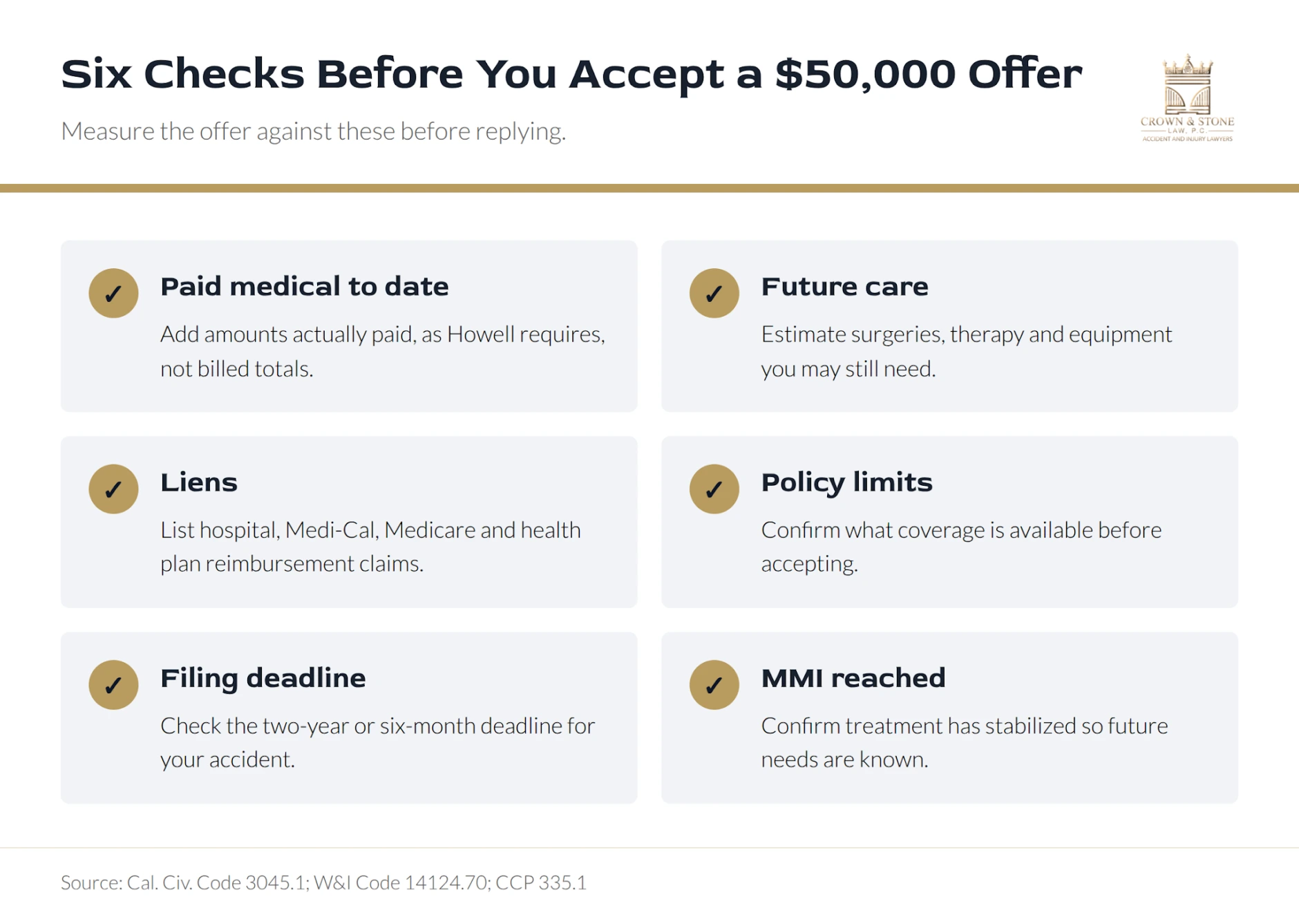
Figure 2: An offer is only good when it covers bills, future care and liens within known limits. Source: Cal. Civ. Code 3045.1; W&I Code 14124.70; CCP 335.1.
$50,000 is reasonable when:
- The injury was minor.
- Treatment has ended and you have healed.
- Known limits sit near $50,000 with no other coverage behind them.
$50,000 is too low when:
- A doctor has recommended surgery.
- Higher policy limits are known.
- Treatment is ongoing and MMI is still ahead.
From Gross Settlement To Net
A gross settlement shrinks once liens and case costs are repaid. The net amount the injured person receives can be far lower than the headline figure.
In this hypothetical $150,000 settlement:
- Hospital lien: minus $12,000, leaving $138,000.
- Medi-Cal or Medicare reimbursement: minus $9,000, leaving $129,000.
- Health plan lien: minus $18,000, leaving $111,000.
- Litigation costs such as filing and records charges: minus $6,000, leaving $105,000.
Those four items take $45,000, or 30% of the gross. Liens can be negotiated. The hospital lien is capped at 50% of the recovery left after prior liens, and Medi-Cal and Medicare reduce their claims for procurement costs, which are the expenses of obtaining the recovery.
Under IRC 104(a)(2), damages for physical injury are generally excluded from income. Punitive damages and interest are taxable.
Which Deadlines Apply To A 2027 Settlement?
The accident date, not the settlement year, sets the deadlines. Most claims must be filed within two years under CCP 335.1, and claims against public entities have a six-month claim deadline.
The statute of limitations is the legal cutoff for filing suit, and it exists so cases are decided while evidence is fresh. An accident on November 16, 2026 meets the two-year filing deadline only if suit is filed by November 16, 2028. A claim against a city or county is due within six months under Gov. Code 911.2, and suit follows within six months of written rejection under Gov. Code 945.6.
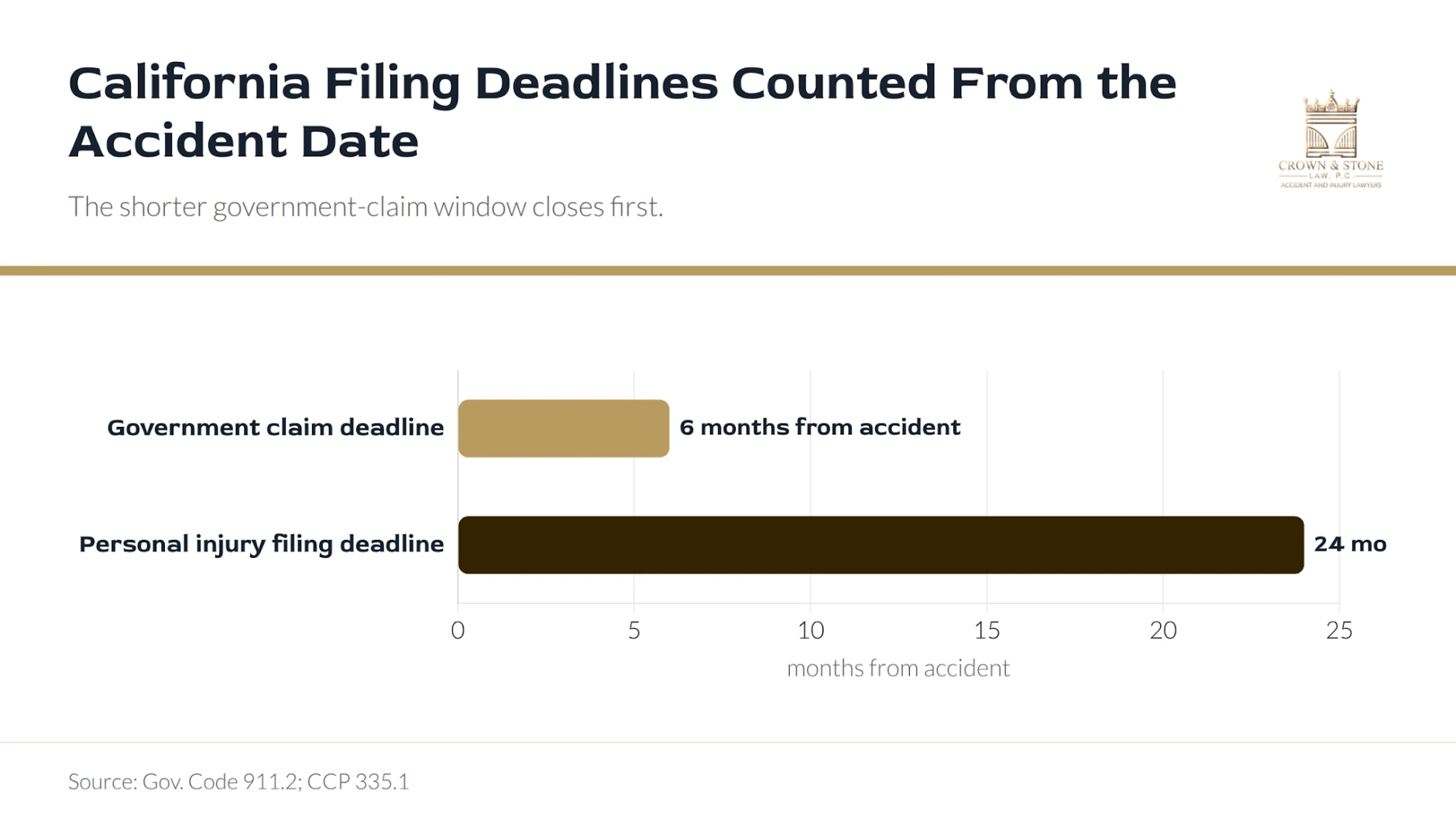
Figure 3: A claim against a public entity must be presented within six months; most others have two years. Source: Gov. Code 911.2; CCP 335.1.
The six-month government deadline is the one that ends the most claims. A time-limited demand, which is a settlement offer that expires on a set date, must give the insurer at least 30 days to respond under CCP 999 to 999.5, or 33 days if mailed.
The usual sequence is treatment, MMI, the demand, the insurer’s response, filing and, if needed, trial. Recovery time drives how long a case takes more than the calendar does.
Talk Through Your Claim With Avi Muhtar
At Crown & Stone, working directly with Avi Muhtar means he handles your claim from the first call to the settlement and explains each step in simple words. Avi and our team gather the medical evidence, policy information and lien details first, so any offer is measured against real numbers. One step you can take today is to keep every bill and every explanation of benefits your health plan sends.