


After a California crash without insurance, an uninsured driver (one with no auto liability policy at the time) who caused the crash is personally liable for the other party’s losses. Every uninsured driver must report the crash to the DMV, and one who was not at fault cannot recover pain and suffering. The penalties and SR-22 rules build on those three facts.
The weeks after a crash can feel like a lot at once. One step for today is to check whether your 10-day DMV report is due.
At Crown & Stone Law, you work directly with our founding attorney to resolve your case.
Key Takeaways
- If you caused the crash, you are personally liable for the other party’s injuries and car damage, and a judgment against you can be enforced for 10 years and renewed.
- Prop 213 (Civil Code §3333.4) bars an uninsured owner or driver from pain and suffering damages, but medical bills, lost wages and car repair remain recoverable.
- You must file the DMV SR-1 report within 10 days if anyone was hurt or damage exceeds $1,000, no matter who was at fault.
An Uninsured Driver Faces 3 Outcomes
The three outcomes are personal liability if you caused the crash, a DMV report and possible suspension either way, and a limit on your recovery if the other driver caused it. Fault decides which apply to you.
If you caused the crash, you answer personally for the other party’s injuries and car damage. No policy stands behind you to pay.
Fault does not matter to the DMV. A crash with injury, death or property damage over $1,000 triggers a report, and a missing report can lead to a license suspension.
If the other driver caused the crash, Prop 213 (Civil Code §3333.4) blocks your pain and suffering. It does not block medical bills, lost wages or car repair.
If the other driver is also uninsured, uninsured motorist coverage is not available to you, because that coverage is part of a policy and you have none. The claim runs against that driver personally.
Does Prop 213 Block An Uninsured Driver’s Claim?
Partly. Prop 213, Civil Code §3333.4, bars an uninsured owner or driver from noneconomic damages (pain, suffering and emotional distress) against an at-fault insured driver. Economic damages, meaning money losses like medical bills, lost wages and repairs, remain recoverable.
The rule turns on your role in the crash and your coverage status. It does not mean an uninsured person cannot sue.
Prop 213 Effect On Claim Value
Prop 213 removes the noneconomic part of the claim. On the same crash, an insured plaintiff’s claim is about $158,000 and an uninsured plaintiff’s recoverable claim is $58,000.
Here is an illustrative example, not a real case. A not-at-fault driver has $40,000 in medical bills, $10,000 in lost wages, $8,000 in car repair and $100,000 in pain and suffering.
Insured, the claim is about $158,000. Uninsured, §3333.4 bars the $100,000 noneconomic portion and leaves $58,000.
Comparative fault is the rule that cuts your recovery by your own share of blame. At 20% fault, the uninsured driver’s $58,000 becomes $46,400.
Once the noneconomic portion is gone, proof of each economic loss carries the whole claim. We gather the medical evidence that ties every bill to the crash. The full range of what damages you can claim reaches past bills and wages to future care.
Who Prop 213 Does Not Bar Uninsured Passengers
Prop 213 does not bar uninsured passengers, pedestrians or cyclists, drivers of a borrowed car insured through the owner’s policy, or plaintiffs hit by a DUI-convicted driver. The barred group is the uninsured owner or driver, and that person still recovers economic losses.
A borrowed insured car is generally not barred because the owner’s policy covers the car. The DUI carve-out applies when the at-fault driver was convicted of DUI. An uninsured person on foot or on a bike brings the same pedestrian injury claims as anyone else.
A lapsed or cancelled policy decides many files. A lapse can mean no coverage on the crash date, so the exact lapse date matters. Keep the cancellation notice and every payment record.
| Role | Pain and suffering barred? | Still recoverable |
|---|---|---|
| Uninsured owner or driver | Yes | Medical bills, lost wages, car repair |
| Uninsured passenger | No | Full claim |
| Uninsured pedestrian or cyclist | No | Full claim |
| Borrowed car insured via owner | Generally no | Full claim |
| Hit by DUI-convicted driver | No (DUI exception) | Full claim |
Figure 1: Only uninsured owners and drivers lose noneconomic damages; other roles keep the full claim. Source: Cal. Civil Code §3333.4.
How Does An Uninsured At-Fault Driver Pay?
The other party’s insurer pays its own customer and then pursues you for repayment, or the injured person sues you directly. Either way, the resulting money judgment is enforceable for 10 years and renewable.
Subrogation is the insurer stepping into its customer’s shoes to recover what it paid. It starts with a demand letter and can end in a lawsuit against you.
Under CCP §683.020, a judgment can be enforced for 10 years. CCP §683.110 lets the creditor renew it for 10 more. The exposure outlasts the crash by years.
The DMV can also suspend your license until the judgment is satisfied or an installment agreement is in place.
SB 1107 raised the minimums to 30/60/15, effective Jan 1, 2025. Under the state’s required insurance limits, that means $30,000 per person for injury, $60,000 per crash for injury and $15,000 for property damage. An uninsured driver skipped that coverage, so those figures now describe personal exposure.
What Deadlines Apply After An Uninsured Crash?
The first deadline is 10 days: file the DMV SR-1 report if anyone was hurt or killed or damage exceeds $1,000. Lawsuit deadlines run 2 years for injury and 3 years for property damage.
At the scene, the Vehicle Code requires every driver to stop and exchange information. The SR-1 duty applies regardless of fault. Notice to an insurer is set by policy language, not by a statute with a number.
The statute of limitations is the legal cutoff for filing a lawsuit, and it keeps cases close to fresh evidence. CCP §335.1 sets 2 years for injury, and CCP §338 sets 3 years for property damage.
A claim against a city, county or state agency must be presented within 6 months under Gov. Code §911.2. The filing deadlines in detail include exceptions that can shift these dates.
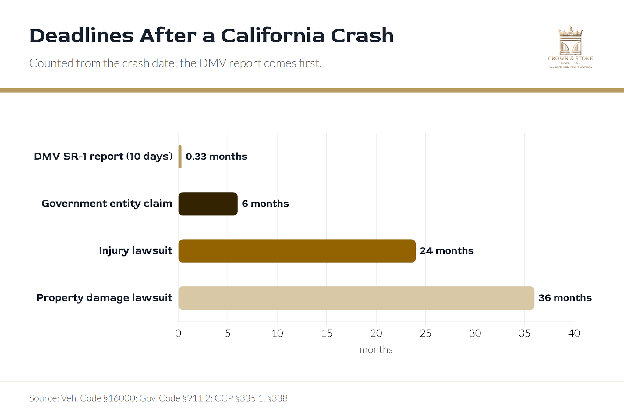
Figure 2: The DMV report is due in 10 days, long before the lawsuit deadlines. Source: Veh. Code §16000; Gov. Code §911.2; CCP §335.1, §338.
SR-22 is a form an insurer files with the DMV to show you now carry coverage. It is typically required for 3 years after a suspension.
Which Mistakes Hurt Uninsured Drivers Most?
Five mistakes come up most: skipping the SR-1, admitting fault to the other insurer, assuming a lapsed policy counts, buying a policy after the crash expecting coverage, and ignoring a summons. Each one damages a claim in a specific way.
The first is skipping the SR-1 because the crash was not your fault. The report duty ignores fault, and missing it risks a suspension.
The second is giving the other insurer an admission or a recorded statement. Those words can be used to assign fault to you and reduce your claim.
The third is assuming a lapsed or cancelled policy still counts. Without the exact lapse date documented, you may be treated as an uninsured driver.
The fourth is buying a policy after the crash. A new policy does not cover a crash that already happened.
The fifth is ignoring a summons. That leads to a default judgment, a court ruling entered because you did not respond.
Knowing how insurers reduce claims shapes the response. If an insurer pushes back, we review every statement you gave, gather the evidence that answers it and rebuild the plan.
How Can You Get Legal Coverage Now?
You have five options: a standard policy, the California Low Cost Auto program, a $35,000 DMV cash deposit, a $35,000 surety bond, or DMV self-insurance. None covers a crash that already happened.
A standard policy pays claims from future crashes up to its limits. Low Cost Auto offers basic coverage to drivers who meet income and vehicle-value limits, and it is available in Los Angeles County.
The cash deposit and the surety bond each stand at $35,000 and prove you can pay. Self-insurance is a DMV certification, not a policy.
None of these is retroactive. The current crash is handled under the rules above.
Did California Change Uninsured Driver Rules For 2027?
No. We found no new 2027 rule for uninsured drivers. Minimums rose to 30/60/15 on Jan 1, 2025, and the next scheduled step to 50/100/25 is in 2035.
Prop 213 and the 10-day SR-1 rule have not changed. Pages still quoting 15/30/5 minimums are outdated. Check the DMV before relying on any claim of a new rule.
Frequently Asked Questions
Do Rates Rise Without Fault?
An uninsured driver has no current policy to raise. The effect shows up in the next policy’s pricing and in your DMV record. Ask any new insurer how it treats a not-at-fault crash before you buy.
Does No-Fault Appear On Your Record?
Yes. The SR-1 report creates a DMV file whatever the fault, which is why filing it matters.
Fault then decides whether liability or a suspension follows. Avi can explain what a specific record shows during a conversation.
Talk With Avi Muhtar About Your Claim
You work with Avi Muhtar directly from the first call to the settlement, and he explains the claim in simple words. Avi and our team gather the medical evidence, study how the crash happened and prepare for how insurers reduce uninsured claims.
Crown & Stone answers 24/7. Start by talking with Avi about your coverage dates and bills. Request Consultation, and you will leave with a clear read on what Prop 213 means for the bills in front of you, plus the next step.