


California has no official average for pain and suffering. The value of a claim depends on how severe the injury is, how much treatment it needs, who was at fault and how much insurance covers. If you are hurting and unsure what comes next, this post shows how to estimate a realistic range for your own injury.
Pain and suffering is the everyday name for non-economic damages, meaning money for harms that come with no receipt, such as physical pain, fear and lost enjoyment of life. Overall injury settlement averages blend bills and wages together.
This post isolates the pain and suffering piece: what counts, how it is calculated, which California rules change it, and a worked example. It is educational only, and no figure here promises an amount.
Is There A California Pain And Suffering Average?
No, California has no official average for pain and suffering. No state agency or court publishes one. Any single figure you see online is pulled upward by a handful of catastrophic results.
An average, or mean, adds every result and divides by the count. If nine claims settle close together and a tenth reaches millions, the mean jumps. The median, the middle result, barely moves, so it is a better picture of a typical claim.
Self-selected numbers mislead too. One widely shared page lists a broad settlement range, then gives a narrower “typical” figure that does not match it. Both come from results the publisher chose to show, not from a complete set of cases.
Severity drives value more than any average does. In general, claims fall into three tiers:
- Sprains and soft tissue injuries that heal within months
- Fractures or injuries that need surgery and a longer recovery
- Permanent brain, spinal cord or amputation injuries with lifelong future pain
We give no dollar ranges for these tiers because no sourced closed-file or published verdict data supports them here. Permanent brain injury claims are valued over the person’s full life expectancy. The same is true of spinal cord injury cases, where future pain can last decades.
Venue is the county where a case would be tried, and it shapes offers. Insurers set their numbers partly on how they expect a Los Angeles County jury to react. They also weigh how strong the medical evidence looks.
What Counts As Pain And Suffering In California?
Pain and suffering is the common name for non-economic damages. That means money for physical pain, mental suffering, emotional distress, inconvenience, loss of enjoyment of life and disfigurement. It includes the emotional and psychological trauma that can follow a crash.
Economic damages are losses with a receipt, such as medical bills and lost wages. Non-economic damages have no receipt, so someone has to put a value on them.
California law sets the goal, not the number. A tort is a civil wrong, such as careless driving, and Civil Code § 3333 measures tort damages as the amount that compensates for all the detriment caused. CACI 3905A, the jury instruction on this point, says there is no fixed standard and asks jurors to use their judgment.
Loss of consortium is the loss of a spouse’s companionship and intimacy. It is a separate claim under CACI 3920, and it belongs to the spouse, not to the injured person.
How Is Pain And Suffering Calculated In California?
California has no formula for pain and suffering. Jurors use judgment under CACI 3905A. Insurers start from two shortcuts, the multiplier method and the per diem method, then adjust for the facts.
An adjuster needs a starting number for a loss with no receipt. The multiplier fits short recoveries, where medical bills tell most of the story. The per diem fits long or lifelong harm, where days of pain can be counted.
Multiplier Method Calculation
The multiplier method multiplies medical expenses by a factor, commonly 1.5 to 5, to estimate pain and suffering. It is an insurer rule of thumb, not a legal standard.
Higher factors fit permanent injury, surgery and long treatment. Lower factors fit soft tissue injuries that heal in weeks. The result is only as sound as the medical number it multiplies.
Per Diem Method Calculation
The per diem method assigns a daily dollar value to the pain and multiplies it by the number of days of suffering. Per diem means “per day.” For a permanent injury, it uses life expectancy instead.
It works best when recovery is long and the medical records show how many days the pain lasted. The daily figure needs a reason tied to the injury and the evidence, such as a day’s wages or the limits pain puts on work and sleep. An adjuster can easily reject a number chosen at random.
Howell Paid Versus Billed Medical Amounts
Past medical damages are limited to what was actually paid or incurred, under Howell v. Hamilton Meats (2011), a California Supreme Court decision. This lowers the base any multiplier starts from.
Billed charges are a provider’s list prices. Paid amounts are what a health insurer actually paid after its negotiated discounts. Under Howell, the paid figure sets past medical damages.
Pebley v. Santa Clara Organics (2018) adds an exception. A lien means the provider is paid from the settlement instead of by insurance. A patient who treats on a lien outside insurance may use the billed amounts as evidence of value.
The gap can be large. Suppose $75,000 is billed and $30,000 is paid. A 3x multiplier on the billed charges gives $225,000, while the same multiplier on the paid amount gives $90,000.
Quoting a multiplier against full billed charges is the mistake built into most online calculators. It sets an expectation that an adjuster will not meet.
Which California Rules Change Pain And Suffering Value?
Four California rules decide whether pain and suffering is reduced, split, barred or capped: pure comparative fault, Proposition 51, Proposition 213 and the medical malpractice cap. Which rules apply depends on how the injury happened and who caused it.
Comparative fault is the rule that gives each person a share of the blame. Li v. Yellow Cab made California’s version “pure.” Your recovery drops by your share of fault, even above half, instead of being barred.
Proposition 51 is Civil Code § 1431.2. Under it, each defendant pays non-economic damages only in proportion to its own fault. If one defendant cannot pay, the others do not cover its share of pain and suffering.
Proposition 213 is Civil Code § 3333.4. It bars pain and suffering for uninsured drivers and uninsured vehicle owners, and for drivers convicted of DUI arising from the crash. Passengers and pedestrians are not barred, and the rules for uninsured drivers still allow economic damages.
Ordinary negligence cases have no cap on pain and suffering. Medical malpractice is different. Civil Code § 3333.2, as amended by AB 35, caps pain and suffering at $350,000, or $500,000 for wrongful death, starting in 2023, and both amounts rise each year.
| Rule | Effect | Authority |
|---|---|---|
| Pure comparative fault | Reduces award by your share of fault | Li v. Yellow Cab (1975) |
| Prop 51 | Each defendant pays only its own share | Civ. Code § 1431.2 |
| Prop 213 | Bars uninsured drivers and owners in car cases | Civ. Code § 3333.4 |
| Medical malpractice cap | Capped; no cap in ordinary negligence | Civ. Code § 3333.2 |
Figure 1: Comparative fault, Prop 51 and Prop 213 shape ordinary claims, while the cap applies to medical malpractice only. Source: Li v. Yellow Cab; Civ. Code §§ 1431.2, 3333.2, 3333.4.
Pain And Suffering Example Using California Rules
One hypothetical claim shows each rule’s effect: $130,000 in total damages falls to $104,000 after a 20% fault share, then meets a $30,000 per-person policy limit. A policy limit is the most an insurance policy will pay for one person’s injuries.
The inputs are $75,000 billed, $30,000 paid and $10,000 in lost wages. A 3x multiplier on the paid medical gives $90,000 for pain and suffering. A per diem of $150 a day for 600 days also gives $90,000.
Adding $30,000 in medical, $10,000 in wages and $90,000 in non-economic damages gives $130,000. A 20% comparative fault share removes $26,000, which leaves $104,000. The at-fault driver’s policy pays no more than $30,000, and the rest depends on other coverage or the driver’s assets.
The steps, in order: set the paid medical base, value the pain and suffering, total the damages, reduce for fault, then check the policy limit.
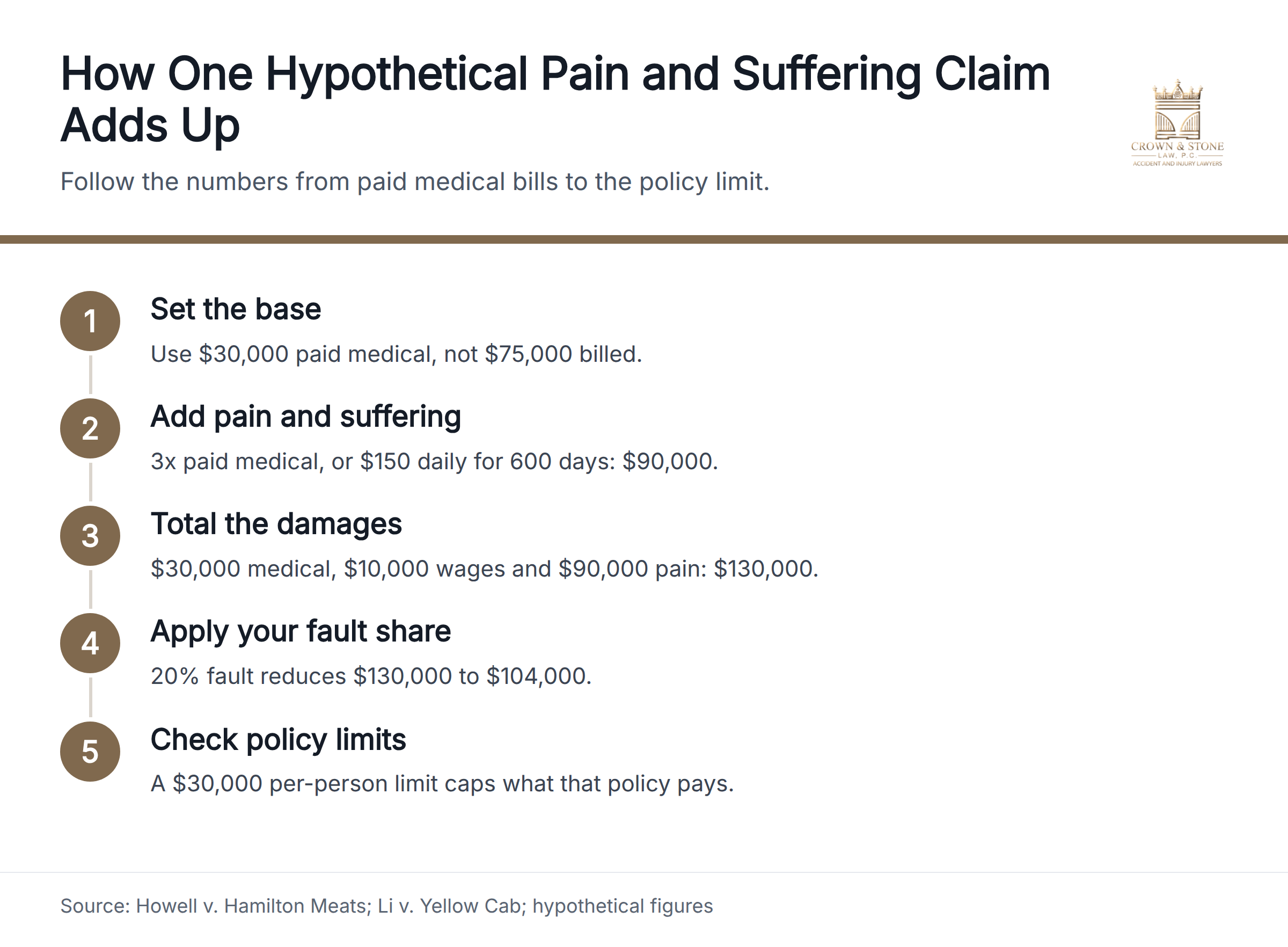
Figure 2: Each California rule changes the number, so the final figure differs from the first estimate. Source: Howell v. Hamilton Meats; Li v. Yellow Cab; hypothetical figures.
The multiplier is an insurer rule of thumb, commonly 1.5 to 5x. This example shows the arithmetic. It is not a prediction for any claim.
How Do You Prove Pain And Suffering?
To prove pain and suffering, document the pain daily, keep treatment continuous and gather outside witnesses. Together, these show how the injury changed your life.
Eight kinds of evidence carry the most weight:
- A daily pain journal with 0 to 10 scores
- Physical therapy or chiropractic notes with pain scores
- Records from treating doctors and surgeons
- Psychotherapy or PTSD treatment records
- Photos of scarring, casts and bruising
- Before-and-after statements from family, coworkers and friends
- An employer statement on missed work and activities
- Your prescription and medication history
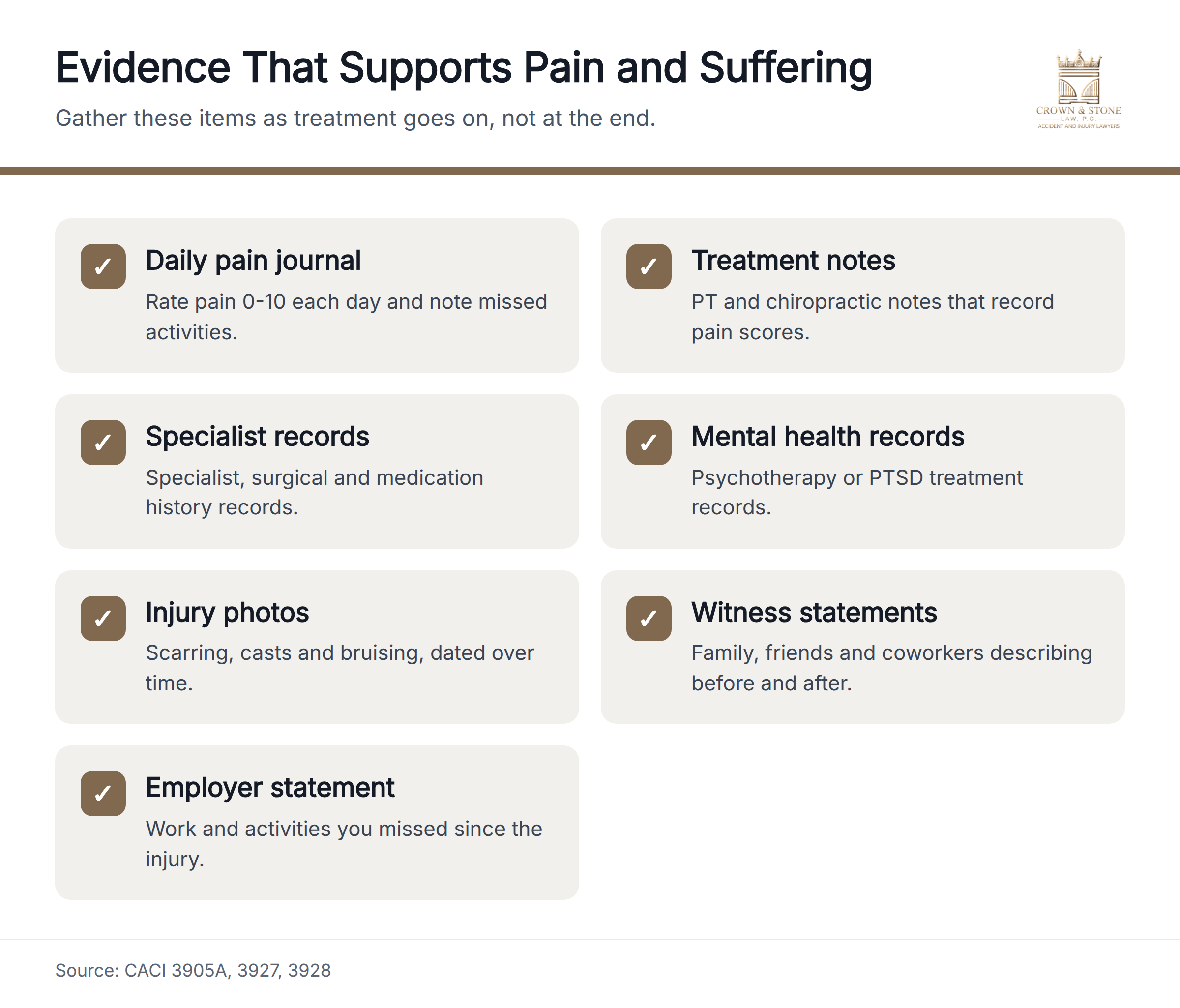
Figure 3: Steady, dated records show jurors and adjusters how the injury changed your daily life. Source: CACI 3905A, 3927, 3928.
Three mistakes weaken a claim:
1. A gap in treatment: an adjuster can argue that you recovered during the gap.
2. Social media posts: a photo from a party or a hike can be used to say the pain is overstated.
3. An early recorded statement: words given before you understand the injury can be quoted against you later.
Avi Muhtar takes over the insurer calls, so you can focus on appointments and recovery.
A pre-existing condition does not end a claim. CACI 3927 allows damages for making an earlier condition worse. Under CACI 3928, an unusually susceptible person recovers for the full harm the injury caused, even if a healthier person would have been hurt less.
Tax Rules And Workers’ Comp Limits
Pain and suffering tied to a physical injury is generally not taxable under federal law, while workers’ comp pays no pain and suffering at all. The tax rule decides how an award is treated. The workers’ comp rule decides whether the award exists in the first place.
Is Pain And Suffering Taxable?
No, pain and suffering tied to a physical injury is generally not taxable. Under IRC § 104(a)(2), a federal rule, damages received on account of personal physical injury or physical sickness are excluded from income.
Three items are taxable: emotional distress damages with no physical injury, punitive damages and interest. A tax adviser can confirm how your own settlement is treated.
Workers’ Comp Bars Pain And Suffering
Yes, workers’ comp bars pain and suffering. It pays for medical care, temporary disability and permanent disability benefits, but no pain and suffering, because of the exclusive remedy rule in Labor Code §§ 3600 and 3602. That rule makes workers’ comp the only remedy against your employer.
A third party is different. If a negligent driver or a product maker caused the work injury, a separate civil claim against that party can include pain and suffering. The employer or its insurer has a lien on that recovery under Labor Code §§ 3852 and 3856, which means it can be repaid for the benefits it paid out.
What Deadlines Affect Pain And Suffering Claims?
The lawsuit deadline for pain and suffering claims is two years from the injury under CCP § 335.1. A statute of limitations is the legal deadline to file a lawsuit, and the two-year filing deadline exists so evidence is still fresh.
Injuries caused by a California public entity, such as a city bus, need a government claim within six months under Gov. Code § 911.2.
Maximum medical improvement is the point where recovery has plateaued, so doctors can describe the pain and care still ahead. A claim valued before that point may settle for less than the injury turns out to need.
A time-limited demand is a settlement offer that expires. CCP § 999 and the sections after it have governed these demands since 2023. In a motor vehicle claim, the demand must give at least 30 days to respond.
The next step is to keep treating and to hold off on valuing or settling until treatment shows the injury’s course.
Frequently Asked Questions
Average Workers’ Comp Settlement In California
No reliable average exists without a sourced dataset, so we give no number. Workers’ comp settlements are not pain and suffering. They depend on the permanent disability rating, future medical needs and wage loss, and the exclusive remedy rule explained above keeps pain and suffering out.
Crown & Stone Prepares Each Claim For Trial
Crown & Stone prepares each claim as if it will go to trial, so a low offer meets a better plan. Avi works with you directly from the first call to the settlement. He takes over the insurance calls, investigates the crash, gathers the medical evidence that shows what the injury did and explains each step in simple words.
One step you can take today is to start a pain journal and keep every appointment. To learn what preparing a case for trial involves, Avi and our team answer questions 24/7. This post is educational only, your claim depends on your own facts, and no amount is promised.