
Yes. An uninsured rider in California can still recover medical bills, lost wages and property damage.
Proposition 213 (Civil Code § 3333.4) is a state law that blocks non-economic damages for uninsured owners and operators. It has a narrow exception that matters in drunk driving crash claims.
Finding out you had no coverage after being hurt is a shock. This post covers what survives, who is barred, who pays and the deadlines.
Avi Muhtar explains it the way he works a claim: the facts decide, and every case is prepared as if it will go to trial. Your next step today is to write down the crash facts and keep every bill and record.
Can An Uninsured Rider Recover Compensation?
Yes, but only economic damages. Under Civil Code § 3333.4, an uninsured rider cannot recover non-economic damages from the other party.
Economic damages are money losses with a paper trail, such as bills and pay stubs. Non-economic damages are harms without a receipt: pain and suffering, emotional distress and loss of enjoyment of life.
The bar looks at your insurance status on the crash date, not at who caused the crash. A rider hit by a driver running a red light is still barred if the bike was uninsured that day.
Which Damages Survive Proposition 213?
An uninsured rider keeps three losses: medical bills, lost wages and property damage. Proposition 213 does not bar these economic damages.
- Medical bills: past treatment and the future care a doctor expects you to need.
- Lost wages: income missed while healing, plus lost earning capacity if the injury limits future work.
- Property damage: the repair cost or the total-loss value of the motorcycle.
How Prop 213 Changes Claim Value
Proposition 213 removes the non-economic part, so the same crash is worth far less to an uninsured rider than to an insured one. Comparative fault, which means a share of blame assigned to you, then cuts what is left.
Take one illustrative crash. Medical bills are $40,000, lost wages are $15,000, non-economic harm is valued at $100,000, and the rider is found 20% at fault.
- Insured rider: $40,000 + $15,000 + $100,000 = $155,000, then $155,000 × 80% = $124,000.
- Uninsured rider: $40,000 + $15,000 = $55,000, then $55,000 × 80% = $44,000.
The two cuts stack. Proposition 213 removes $100,000 first, and the 20% fault reduction applies to the smaller number. These figures are illustrative only and are not predictions for any real claim.
Who Does Proposition 213 Bar?
It bars an injured person who owned an uninsured vehicle involved in the crash. It also bars an injured person who operated a vehicle without being able to show financial responsibility, meaning proof they could pay for harm they cause.
Defense carriers raise this bar early to cut the non-economic part of the claim. We check the facts before accepting their reading.
Which Conditions Trigger Prop 213?
Owning or operating a motorcycle without insurance or other proof of financial responsibility triggers the bar. Owner and operator status are tested separately, and meeting either one is enough. These cases come up most:
- Lapsed policy: a policy that lapsed before the crash date still triggers the bar.
- Later policy: buying coverage after the crash does not cure it.
- Car policy: a car policy generally does not insure a motorcycle, so the policy’s list of covered vehicles decides.
- Alternative proof: a DMV-recognized bond, cash deposit or self-insurance certificate can establish financial responsibility.
- DUI conviction: the bar lifts under § 3333.4(c) if the at-fault driver was convicted of DUI for that crash.
- Passenger: a non-owner passenger is generally not subject to the bar.
Separate from Proposition 213, there are penalties for driving uninsured that apply even when no one is hurt.
What Exceptions Lift Prop 213?
Two exceptions lift Proposition 213: the at-fault driver’s DUI conviction for that crash, and non-owner passenger status.
Civil Code § 3333.4(c) is the DUI exception, and the conviction must be for the same crash. An arrest alone, or a DUI from another date, does not lift the bar.
A passenger who owns no uninsured vehicle involved in the crash is generally not subject to the bar. That holds even when the person operating the motorcycle had no coverage.
How Are Economic Damages Proven Without Insurance?
Through records: medical bills, wage proof and repair or total-loss valuations. They are the only damages left, so how they are valued drives the whole claim.
In Howell v. Hamilton Meats (2011), the California Supreme Court held that when health insurance paid the bills, past medical damages are limited to amounts actually paid, not amounts billed. In Pebley v. Santa Clara Organics (2018), a Court of Appeal held that treatment on a lien may be measured differently. A lien means the provider is paid from the recovery instead of through insurance.
MedPay, which is medical payments coverage, is part of the rider’s own policy, so an uninsured rider has none. Avi looks at how treatment is documented early, because gaps in care give an insurer room to call the injury minor.
Five records carry the claim: medical records and bills, wage statements or tax returns, an employer letter, a repair estimate or total-loss valuation, and helmet and gear receipts.
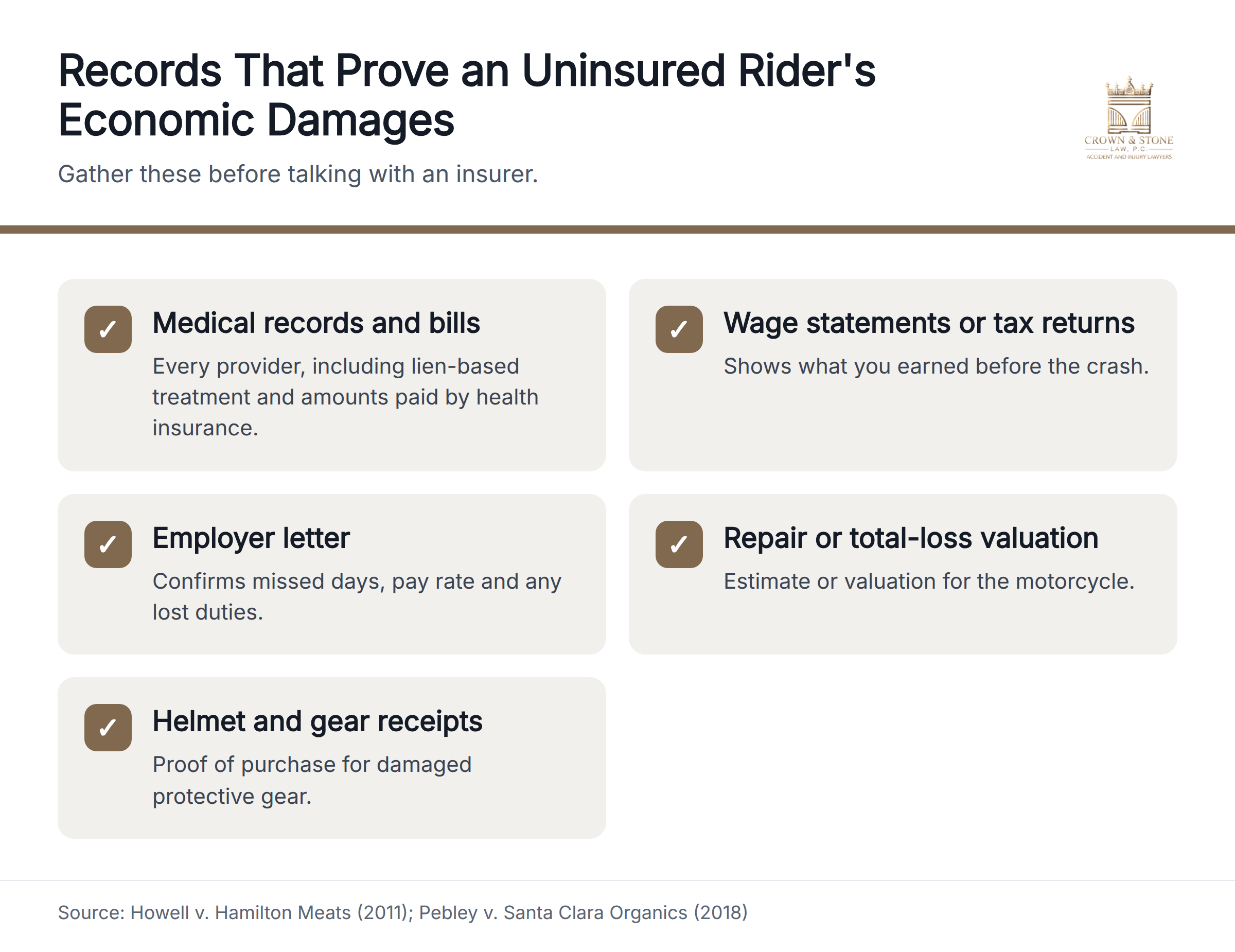
Figure 1: Economic damages are the whole recoverable claim, so each record matters. Source: Howell v. Hamilton Meats (2011); Pebley v. Santa Clara Organics (2018).
Comparative Fault Reduces An Uninsured Rider’s Recovery
Your recovery is reduced by your percentage of blame. California uses pure comparative negligence under Li v. Yellow Cab Co. (1975), which means a rider found partly at fault is reduced, not barred.
Lane splitting is legal under Vehicle Code § 21658.1, but insurers still argue the rider moved at an unsafe speed for traffic or conditions. Vehicle Code § 27803 requires a helmet, and an insurer may argue that not wearing one made head injuries worse.
If the insurer blames your speed or gear, we answer with evidence: scene photos, damage patterns, video and the speeds those facts support. That investigation starts before an offer arrives.
Who Pays Based On The At-Fault Driver?
It depends on the at-fault driver’s status: insured, uninsured or unidentified. Uninsured/underinsured motorist (UM/UIM) coverage, under Insurance Code § 11580.2, pays you when the at-fault driver has no or too little insurance. It belongs to the rider’s own policy, so an uninsured rider has none.
An uninsured rider and an uninsured motorist claim are two different things. The claim runs against your own insurer and requires that you had a policy. For an uninsured rider, recovery runs only through the driver’s insurer or the driver personally.
| Question | Driver insured | Driver uninsured | Driver unidentified |
|---|---|---|---|
| Who pays | Driver’s liability insurer | Driver personally | Nobody until driver is found |
| Damages recoverable | Economic only | Economic only | Economic only, if identified |
| Collection path | Negotiate, then sue | Judgment, garnishment, levy | Identify driver first |
| Rider’s UM coverage | None | None | None |
Figure 2: The other driver’s status decides who pays, but an uninsured rider keeps only economic damages in every scenario. Source: Cal. Civ. Code § 3333.4; Ins. Code § 11580.2.
An Insured Driver’s Policy Pays
An insured driver’s policy pays the rider’s economic damages, reduced by the rider’s fault percentage. Proposition 213 still removes non-economic damages, so expect the insurer to raise it in negotiation.
Policy limits, which means the most a policy pays for one claim, cap what that insurer pays. Avi checks those limits before anyone talks about numbers.
Is Suing An Uninsured Driver Worthwhile?
Sometimes. It is worthwhile when the driver has income or assets we can reach after a judgment, which is a court’s order that someone owes money.
Under Code of Civil Procedure § 683.020, a money judgment is enforceable for ten years and can be renewed. Collection tools include wage garnishment, which takes part of each paycheck, and bank levies, which take funds from an account.
Under the Financial Responsibility Law, Vehicle Code § 16370 and following sections, the DMV can suspend the license of a driver with an unsatisfied judgment. That gives the driver a reason to pay.
Three signs suggest a judgment may be collectable:
- A steady job with regular wages.
- A home the driver owns.
- Funds in a bank account.
A driver with no job, property or savings is judgment-proof. The judgment exists on paper but cannot be collected.
Why Hit-And-Run Claims Stall
An uninsured rider has no UM coverage, so the claim exists only if the driver is identified. Without a name, there is no one to pay.
Even insured riders face conditions under § 11580.2 for an unidentified driver: physical contact with the vehicle and a prompt police report. A car that cuts off a rider and never touches the bike can leave an insured rider without that UM claim.
For an uninsured rider, identifying the driver is the whole claim. Four kinds of first-hours evidence matter:
- Witness names and phone numbers.
- The plate number, even a partial one.
- Nearby business, home and traffic cameras.
- The 911 call recording.
Camera footage is overwritten quickly, so preservation requests go out first.
Which California Deadlines Apply?
The first deadline is 10 days: file the DMV SR-1 report if the crash caused injury, death or property damage over $1,000 (Vehicle Code § 16000). The duty applies whether or not you had insurance.
Four deadlines apply, in order:
1. 10 days: SR-1 report to the DMV under Vehicle Code § 16000.
2. Six months: claim against a public entity, such as for a road defect, under Government Code § 911.2.
3. Two years: lawsuit for personal injury under Code of Civil Procedure § 335.1.
4. Three years: lawsuit for property damage under Code of Civil Procedure § 338.
A statute of limitations is the legal deadline to file a lawsuit, and we confirm the filing deadlines that apply early. Driving without proof of financial responsibility carries a fine plus assessments under Vehicle Code § 16029, and the bike may be impounded.
Frequently Asked Questions
Must I Report A Non-Fault Accident?
Yes, if a policy was active on the crash date. Its notice terms generally require prompt reporting, even after a non-fault accident.
If there was no policy, there is no insurer to tell. The 10-day DMV SR-1 report applies either way.
Will Rates Rise Without Fault?
That depends on the insurer and the policy, so we do not predict rate changes. For this claim, what matters more is whether coverage was active on the crash date. A policy bought afterward does not lift Proposition 213.
Talk Through Your Claim With Avi Muhtar
Your next step is to write down what you remember and gather your bills and wage records. Bring them when you start talking through your motorcycle accident with Avi. You work with Avi directly, from the first call to the settlement, and he explains your case in simple words.
Avi has practiced law since 2008 (State Bar of California #260728). Crown & Stone Law, P.C. prepares each claim as if it will go to trial and builds a better plan when an obstacle appears.
We answer 24/7. This post is educational information only, not legal advice for your situation.