

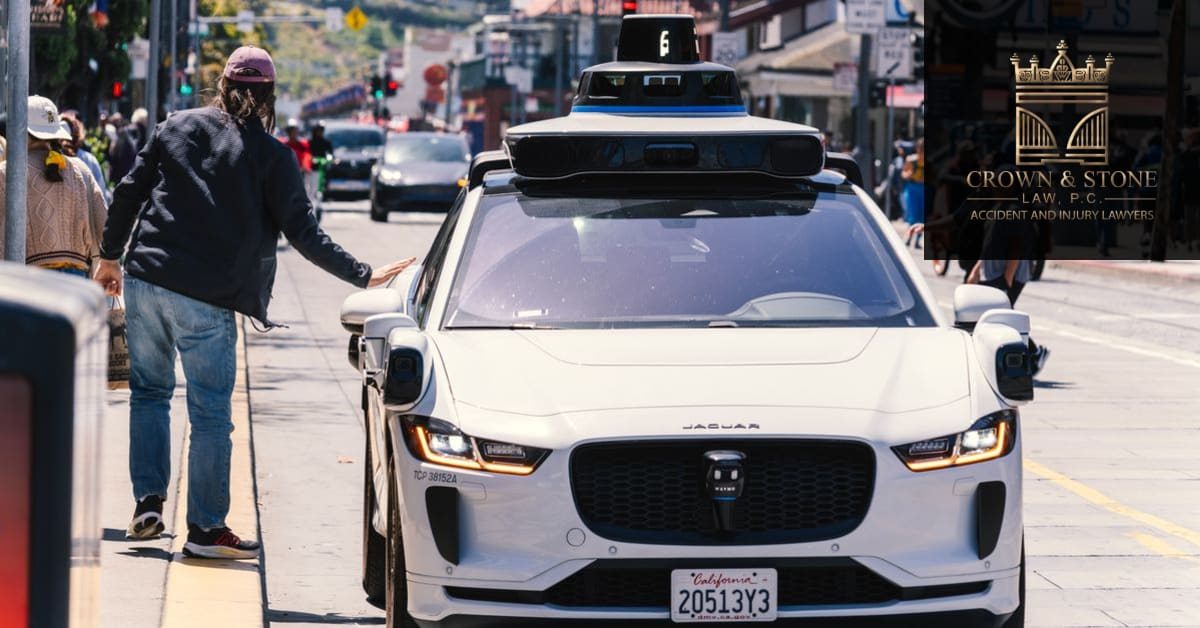
When a Waymo autonomous vehicle (AV) causes a crash, Waymo LLC and its insurance usually owe your damages, because no driver exists to blame. If another driver caused the collision, that driver’s insurer pays. Liability, which means legal responsibility to pay for harm someone caused, follows fault in driverless car crash claims just as it does in any other crash.
Being hurt with no driver to talk to is unsettling. This post is educational and is not advice for your specific case.
Who Pays When A Waymo Hits You?
Waymo LLC, the Alphabet subsidiary that owns and operates the vehicle, pays through its insurance or self-insurance when the Waymo is at fault. If someone else caused the crash, that party pays. The payer depends on who caused the collision, not on the car being driverless.
Self-insurance means the company pays claims from its own funds instead of buying a policy. Either way, the claim runs against Waymo LLC, not a person in the car.
Which Parties Can Be Liable?
There are four possible payers: Waymo LLC, another driver, a maker of the AV system or its parts, and a city or county when a road defect or signal failure contributed. Waymo LLC is the main defendant as owner and operator. A software or parts maker is reached through product liability, which holds a company responsible for a defective product.
If another driver forced the Waymo into you, that driver’s insurer pays too. Splitting fault matters because of Proposition 51 (Civ.
Code §1431.2). Under it, each defendant pays only its own share of non-economic damages, such as pain and suffering.
Your own coverage can also respond. UM/UIM (uninsured or underinsured motorist coverage) pays when an at-fault driver has no insurance or too little. MedPay (medical payments coverage) pays medical bills regardless of fault, which helps when other coverage is disputed or short.
How Much Insurance Must Waymo Carry?
California Vehicle Code §38750(c)(3) requires an AV manufacturer to keep $5,000,000 in insurance, a surety bond or self-insurance. That is far more than most at-fault drivers carry. A surety bond is a promise by another company to pay if the manufacturer does not.
Drivers buying new policies since Jan. 1, 2025 need only 30/60/15 under SB 1107 (Veh. Code §16056).
That means $30,000 for one person’s injuries, $60,000 for all injuries in one crash and $15,000 for property damage. Policy limits are the most an insurer will pay, and a serious injury can pass $30,000 quickly.
Waymo’s DMV deployment permit and its California Public Utilities Commission (CPUC) terms can add conditions. We check the current requirements for each claim.
How Does Your Role Affect A Waymo Claim?
Your role as pedestrian, cyclist, motorcyclist, other driver or Waymo passenger sets the likely defendants, the coverage that responds and whether Waymo’s rider terms can apply. The rider terms are the terms of service a passenger accepts in the Waymo app. Pedestrians, cyclists, motorcyclists and other drivers never accepted them, so they do not bind those people.
Passengers are in a different spot. Their terms may include an arbitration clause, which sends disputes to a private decision-maker instead of court, or steps for giving notice of a claim. Read those terms before anything else is decided.
People outside the car carry the hardest physical risk. Cyclists and motorcyclists have no frame around them, so fractures and head injuries are common. Pedestrian crash claims follow the same fault rules against Waymo.
| Your role | Likely defendants | Coverage that responds | Rider terms apply? |
|---|---|---|---|
| Pedestrian | Waymo LLC; other drivers; city if defect | Waymo AV coverage; own MedPay | No, never accepted |
| Cyclist | Waymo LLC; other drivers; city if defect | Waymo AV coverage; own UM/UIM | No, never accepted |
| Motorcyclist | Waymo LLC; other drivers | Waymo AV coverage; own MedPay, UM/UIM | No, never accepted |
| Driver of another car | Waymo LLC; other drivers | Waymo AV coverage; own UM/UIM, MedPay | No, never accepted |
| Waymo passenger | Waymo LLC; other drivers | Waymo AV coverage; own MedPay | Yes, arbitration or notice possible |
Figure 1: Your role decides who you claim against and whether Waymo’s rider terms can apply. Source: Cal. Veh. Code §38750; Cal. Civ. Code §1431.2.
Which Legal Theories Prove Waymo Fault?
There are three theories: negligence, negligence per se under the Vehicle Code, and strict product liability for a design defect. Fault is proved mainly from data logs and the violation record. Negligence is failing to use reasonable care, the care a careful person would use in the same situation.
As of this writing, no controlling California appellate ruling decides whether Waymo’s software is held to a reasonable-human-driver standard. With no driver to question, the claim leans on data instead of testimony. The basics of how negligence is proved still apply: duty, breach, cause and harm.
Negligence Per Se And Product Liability
Negligence per se means breaking a Vehicle Code safety rule is treated as proof of carelessness (Evid. Code §669).
A Waymo that runs a red light or fails to yield in a crosswalk fits this theory directly. Product liability targets a defective AV system.
A design defect can be tested two ways. Under the consumer-expectations test, a product is defective if it did not perform as safely as an ordinary person would expect. Under the risk-benefit test, it is defective if the risks of the design outweigh its benefits.
The maker can also be liable for a manufacturing defect, meaning a flaw in one unit, or for failure to warn of a known risk.
Does AB 1777 Help Prove Fault?
Yes, it can help. AB 1777 lets police issue a notice of AV noncompliance to the manufacturer for moving violations, and since July 1, 2026, a driverless car can be cited this way. A civil claim does not depend on one.
A notice is useful evidence that the Waymo broke a traffic rule. Without it, fault can still be shown from the data. Ask the officer to note the vehicle’s unit identifier in the report so the right car is tied to the collision.
What Evidence Proves A Waymo Crash Claim?
Waymo crashes leave records that ordinary crashes do not: sensor and camera data, a DMV collision report and federal crash reports. Some of it disappears unless someone asks for it to be kept. Under NHTSA Standing General Order 2021-01, AV companies also report qualifying crashes to the National Highway Traffic Safety Administration.
The habits behind collecting crash evidence in other cases apply here, with more data sources.
First Steps After A Waymo Crash
Call 911, get medical care, photograph the scene, report the crash and avoid recorded statements to Waymo’s insurer until you understand your rights. Get checked even if you feel fine, because adrenaline can hide pain for hours. One doctor’s visit protects your health and your record.
Photograph the vehicle, its roof sensors and any fleet number, plus the road and your injuries. Ask for the police report and the officer’s note of the unit identifier. If the insurer calls, give basic facts only, and do not accept a quick settlement while treatment continues.
Which Waymo Records Should You Request?
There are five items: the police report, the DMV Form OL 316 collision report, a written preservation request to Waymo LLC, nearby camera footage, and photos of the vehicle.
1. Police report: ask the officer to note the vehicle’s unit identifier.
2. Form OL 316: the manufacturer files it with the DMV within 10 days (13 CCR §227.48), and it can be looked up.
3. Preservation request: a written demand that Waymo LLC keep sensor, camera, telemetry and remote-assistance logs.
4. Camera footage: ask nearby businesses and Metro or city camera operators to save video before it is overwritten.
5. Vehicle photos: capture the roof sensors and any fleet number.
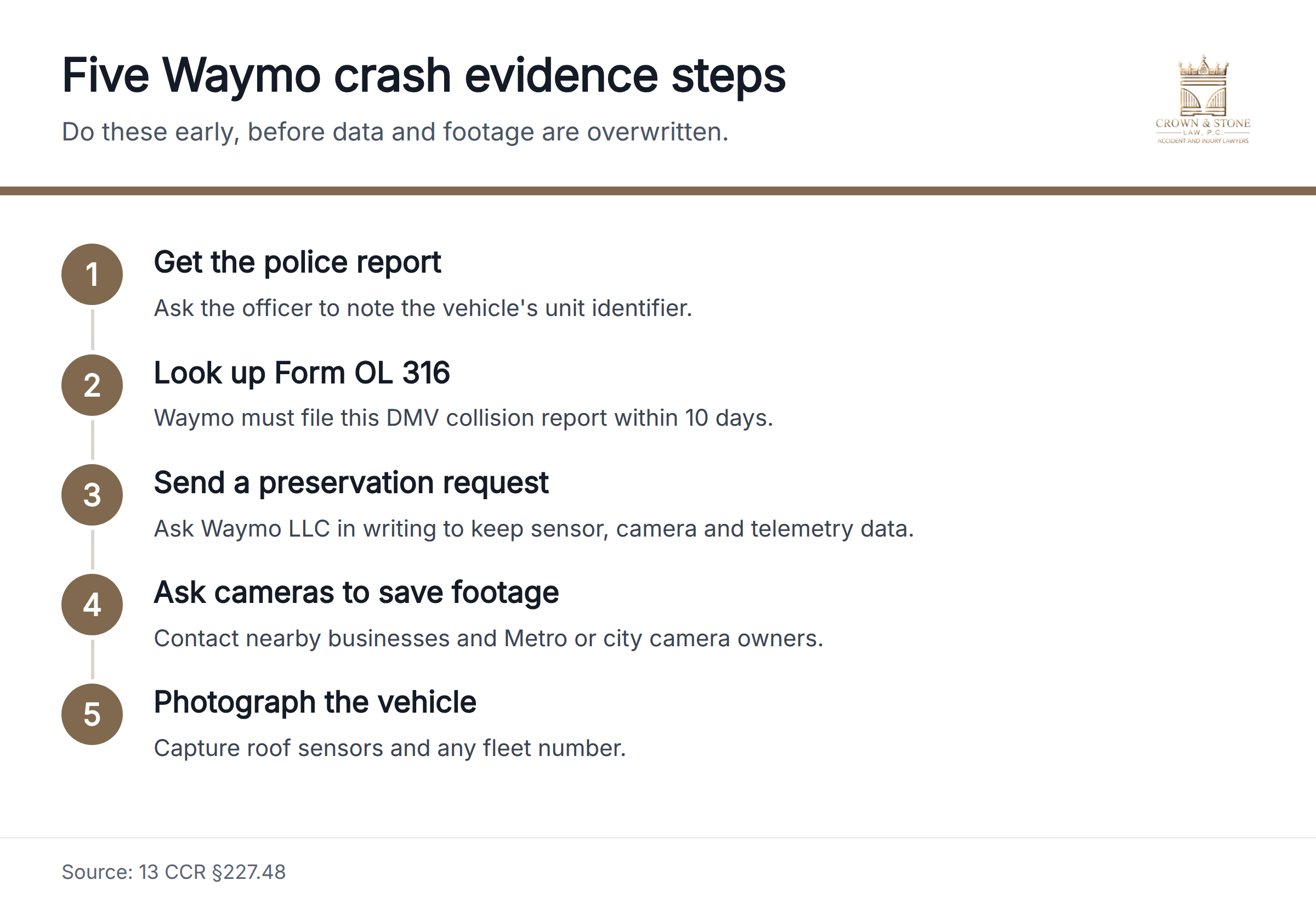
Figure 2: Five early actions secure records that exist only because the car is a Waymo. Source: 13 CCR §227.48.
Remote-assistance logs matter because a human operator may have advised the car before impact.
How Does California Comparative Fault Reduce Recovery?
Under pure comparative negligence, your payment drops by your percentage of fault but is never barred. Comparative fault means blame is split among everyone involved, including you, as the California Supreme Court held in Li v. Yellow Cab. Medical liens and reimbursement claims then reduce what you keep.
Waymo’s insurer may argue you stepped into the street early or rode too fast. That argument is tested against the same data logs, so the evidence shapes your percentage too.
Comparative Fault Cuts A $100,000 Award
If your damages total $100,000 and you are 20% at fault, your award is $80,000. The math is $100,000 minus 20%, or $20,000. At 50% fault, the award is $50,000, and you still recover.
Damages include medical bills, lost income and pain and suffering. Under Howell v. Hamilton Meats, past medical expenses are limited to amounts actually paid or incurred, not the full billed price. Whiplash treatment and injection costs follow the same rule.
Liens Reduce A $20,000 Waymo Settlement
Liens, which are claims on your settlement by those who paid your bills, come out before you receive the balance. A $20,000 settlement can shrink sharply. This illustration uses round numbers only:
- Health insurer reimbursement: $4,000
- Hospital lien under Civ. Code §3045.1: $3,000
- MedPay reimbursement: $2,000
That leaves $11,000. If Medi-Cal paid for your care, the state makes its own reimbursement claim the same way.
Liens are often negotiable, so reviewing each one is part of the plan. Value turns on your injury, treatment, fault share and the coverage, which is what settlements depend on far more than any average.
What Deadlines Apply To A Waymo Claim?
You generally have two years from the crash to file a personal injury lawsuit (CCP §335.1), and six months to present a claim if a public entity shares fault (Gov. Code §911.2). A statute of limitations is the legal deadline to sue. Wrongful death claims also carry a two-year deadline under CCP §335.1.
The six-month rule applies when a city or county road defect, signal failure or public vehicle also contributed. A public-entity claim is a written form filed with the agency before any lawsuit. Put the two-year filing deadline and any six-month date on your calendar today.
Passengers should check Waymo’s terms for claim-notice or arbitration steps. The deadline for a minor or an incapacitated person may be tolled, meaning paused.
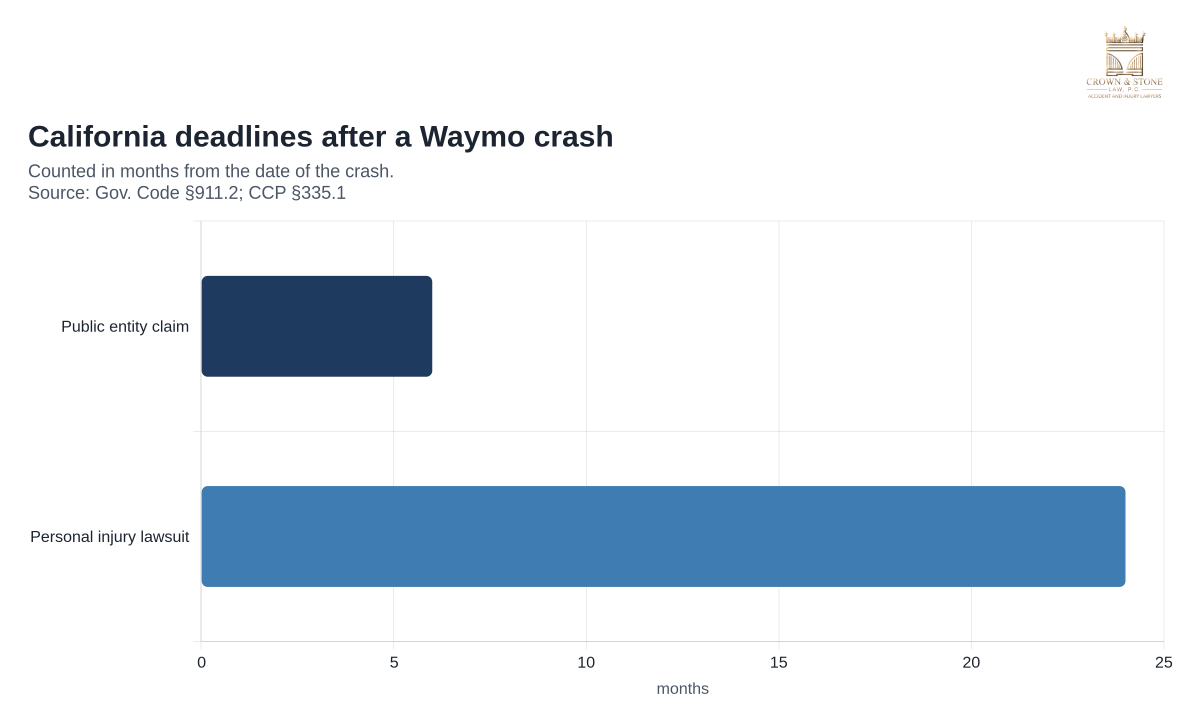
Figure 3: A public-entity claim is due in six months, far sooner than the two-year lawsuit deadline. Source: Gov. Code §911.2; CCP §335.1.
Frequently Asked Questions
Is It Worth Suing For Whiplash?
Whiplash can be worth pursuing, because this soft-tissue neck injury can bring real medical bills and lost work. Value depends on documented treatment, your fault share and the available coverage. Early medical records matter more than the label.
Do Injections Increase Your Settlement?
Not automatically. Injections add treatment costs, but only amounts actually paid or incurred count under Howell. The effect depends on medical support for the care and the insurer’s view of whether it was necessary.
What Is The Average California Settlement?
No single average fits a Waymo claim, and an unsourced figure would mislead you. Value moves with injury severity, treatment, lost income, fault share and available coverage. The settlement factors above give a truer picture of your own claim.
Avi Muhtar Can Map Your Waymo Claim
Avi Muhtar can map your Waymo claim, starting with the step that matters now: save your evidence and send the preservation request before the data is overwritten. Avi takes over the insurer calls, explains each step in simple words, answers your questions and reaches out when something matters.
He has handled litigation since 2008 (State Bar of California #260728). We prepare every case as if it will go to trial, so a low offer or a rider-terms argument gets a better plan, not surrender.
Avi and our team also help with the practical side, such as getting to appointments, as we do in rideshare crash claims. This post is educational only and is not legal advice for your situation.