

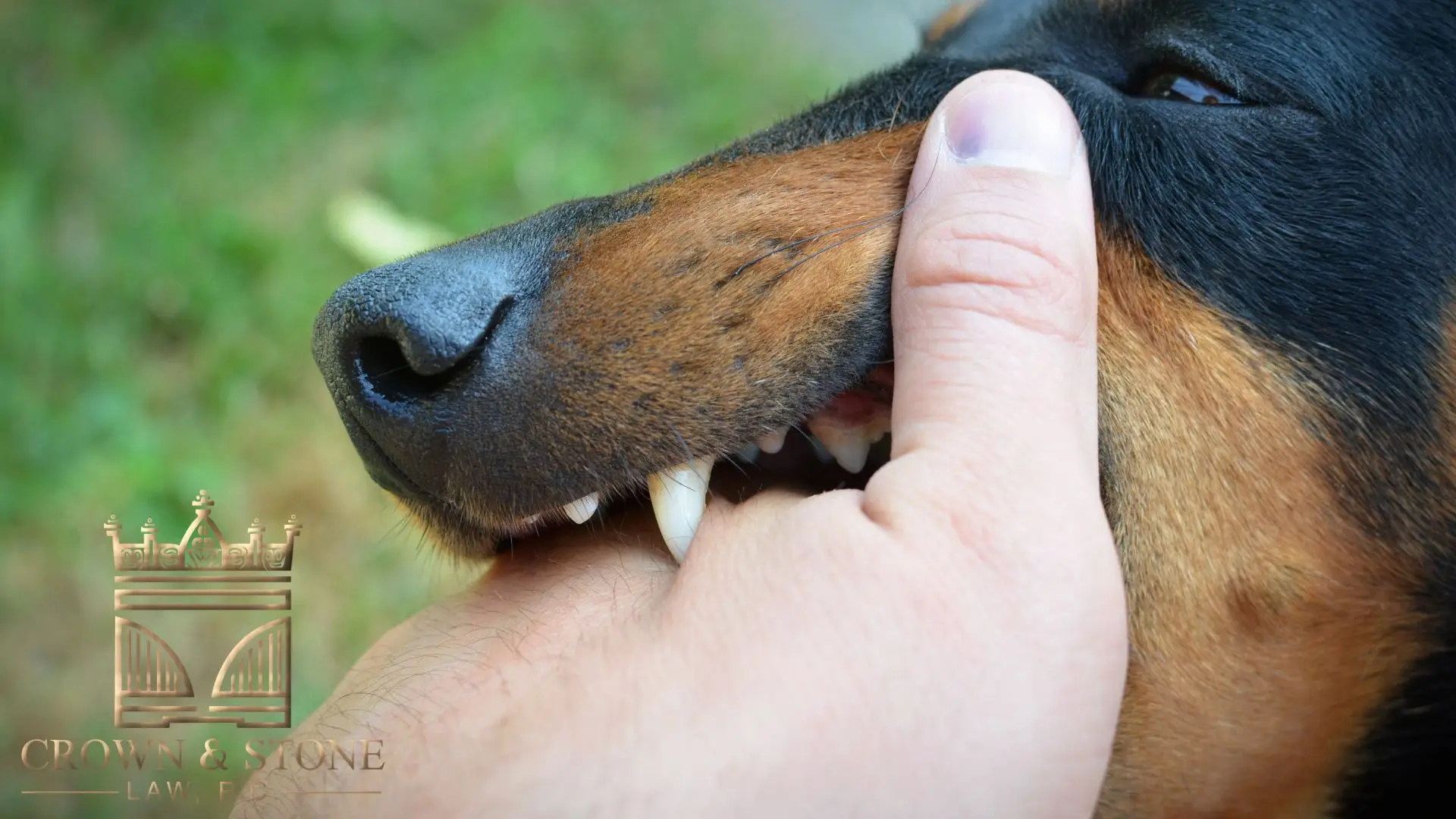
If you are reading this, you or a loved one has likely just experienced the physical and emotional trauma of an animal attack. Right now, you are probably balancing medical treatments with a flurry of conflicting advice.
At this stage in your evaluation process, you need a clear framework to understand exactly where your case stands and what your recovery could look like.
California’s animal attack laws are highly specific, and unfortunately, many victims are told they “do not have a case” simply because their injuries do not fit a narrow, conventional definition of a dog bite.
At Crown and Stone Law, we break down the realities of California dog bite claims, separating legal myths from actionable facts, so you can make confident decisions about your future.
Key Takeaways
- California dog owners can be strictly liable for bites even if the dog has never bitten anyone before, and a “bite” may still qualify even when the skin is not broken.
- Non-bite animal injuries, such as a dog knocking someone down or causing a serious scratch, may still support a claim through general negligence or premises liability.
- Dog bite and animal attack claims should account for the full impact of the injury, including medical care, scarring, psychological trauma, lost earning capacity, and the need to identify the owner or insurance coverage.
Understanding California Civil Code § 3342
Under California Civil Code § 3342, dog owners are held strictly liable for damages if their dog bites someone in a public place or lawfully in a private place.
Unlike many other states, California is not a “one-bite rule” state. This means it is completely irrelevant whether the owner knew the dog had a dangerous propensity or if the dog had never bitten anyone before. If a bite occurs, the owner is liable. Period.
But here is where many victims, and even less experienced attorneys, leave money on the table: the legal definition of a “bite.”
The “Invisible Bite” Clause
One of the most pervasive myths is that you cannot file a strict liability claim if the dog didn’t break your skin. This is categorically false. In the precedent-setting case Johnson v. McMahan, the court established that a “bite” occurs the moment a dog’s jaws close on a victim, even if the skin is not punctured and no blood is drawn.
If a dog clamps down on your jeans, causing severe bruising, tissue damage, or crush injuries without a single scratch, you still have a powerful strict liability claim. Do not let an insurance adjuster convince you otherwise.
When the Dog Doesn’t Bite: Winning Under General Negligence
What happens if a massive dog charges at you, knocking you to the pavement and causing a severe spinal cord injury or traumatic brain injury, but never actually bites you?
Because Civil Code § 3342 applies exclusively to bites, victims of “non-bite” injuries are often wrongfully turned away. This is the intersection where legal experience matters. If you are injured by an animal’s actions rather than its teeth, your claim pivots from strict liability to General Negligence or Premises Liability.
To win a negligence claim, we must prove the owner failed to exercise reasonable care in controlling their animal. This applies to:
- A dog jumping on a child or elderly person, causing broken bones.
- An aggressive dog scratching a victim, leading to serious infections.
- Property damage, including bizarre but highly destructive scenarios like an aggressive dog biting through the tires of a bicycle or vehicle, causing a secondary accident.
Securing maximum compensation in negligence cases requires aggressive advocacy and thorough investigation to prove the owner’s failure to act responsibly.
Calculating the True Cost of an Attack
A vital part of your evaluation is understanding what is a claim actually worth?
While every case is unique, average dog bite settlements in California typically range from $30,000 to $200,000+. However, when catastrophic injuries occur, the compensation ceiling rises dramatically.
Consider the highly publicized case of NBA player Aaron Gordon, who suffered severe facial lacerations from a Rottweiler attack requiring 21 stitches.
In high-stakes cases involving specific, powerful breeds (like Rottweilers or Pitbulls) or attacks targeting the face and hands, the core of the compensation isn’t just the immediate emergency room bill. It centers heavily on:
- Disfigurement and Future Medical Care: Severe bites often require multiple reconstructive surgeries and laser scar revision over several years.
- Psychological Trauma: The invisible wounds of an animal attack, PTSD, anxiety, and the loss of enjoyment of life, frequently demand higher compensation than the physical injuries themselves.
- Lost Earning Capacity: If nerve damage in a hand prevents you from performing your job, your settlement must account for your financial future.
Handling Unidentified Animals
One of the most terrifying scenarios involves a “hit-and-run” animal attack, a fear shown in recent viral news stories like “The Hubbards” case out of state. When an owner grabs their dog and flees the scene before you can get their information, you are left facing an immediate medical crisis.
Post-Exposure Prophylaxis (PEP) for rabies is not only painful but incredibly expensive. If you are bitten by an unidentified dog, you must act swiftly:
- Seek Medical Attention Immediately: Do not wait. Document every injury and begin prophylactic treatment if advised by a doctor.
- File a Police and Animal Control Report: Creating an official record is vital for any future insurance claim.
- Launch an Investigation: By pulling neighborhood security footage, interviewing witnesses, and utilizing private investigators, we can often identify the fleeing owner and tap into their homeowner’s or renter’s insurance policy to cover your medical trauma.
Cross-State Nuances
For transplants or travelers, understanding regional variations in animal law is crucial. For instance, California leads the nation in animal welfare protection intersecting with premises liability. Under California’s AB 797 (the “Right to Rescue Act”), citizens have civil and criminal immunity if they must break into a hot car to save an animal in distress.
Conversely, states like Texas lack these specific blanket protections for citizens, showing just how localized animal-related liability can be. If your incident involves crossing state lines or dealing with out-of-state property owners, make sure your representation understands California’s specific statutory landscape is non-negotiable.
Securing Your Future After an Animal Attack
Evaluating your legal options after a dog bite or animal attack requires looking past surface-level advice. You need an advocate who understands the nuances of the “invisible bite,” who knows how to pivot to negligence when strict liability doesn’t apply, and who brings over a decade of litigation experience to the negotiating table.
At Crown and Stone, we provide personalized, empathetic, and aggressive legal representation, so you can step back from the stress of dealing with insurance companies and focus entirely on your physical and emotional recovery.